Movie Review
Movie Review: ‘Her’
http://www.youtube.com/watch?v=WzV6mXIOVl4
A man falls in love with an operating system. Cue jokes about introverted geeks who rely on the Internet for social interaction, or maybe a scathing critique of how technology runs our lives, blah blah blah. We’ll get the inevitable scene in which the protagonist’s friend shakes him from his techno-stupor. “She’s not even REAL,” the friend will insist, after which the protagonist will come to the world’s most obvious epiphany—that relationships with other humans are inherently more satisfying than those with computers. There’ll be the outlandish date scene in which the protagonist takes his digital girlfriend out in public to the astonishment of a passerby. And then there’s the squirm-worthy sex scene, in which the protagonist awkwardly attempts foreplay with a machine. It’ll all be fun and games and porn jokes, and then it will end with our protagonist in the arms of a real, flesh-and-blood girlfriend because he’s now overcome his crippling social anxiety.
“Her” could have been that film; it’s not. Yes, it contains some of the scenes above, but they’re used in service of the film’s ideas. And “Her” is full of ideas. It’s an exploration of what we need from relationships and why we seek them in the first place. It examines our evolving relationships with technology and our occasional desire for perpetual stimulation to distract us from the turmoil within ourselves. It’s astonishingly beautiful in every sense of the word, and it’s the best film I’ve seen in years.
Fittingly, it’s written and directed by Spike Jonze, a man whose three previous films also asked the big questions that sit at the center of human existence. His debut, “Being John Malkovich,” grappled with identity, while his sophomore feature, “Adaptation,” pondered the perils of attempting to express beauty that defies words. “Where the Wild Things Are,” his third effort, revealed itself to be a meditation on the seemingly formless jumble of emotions that is childhood. Thematically, they sound like the kinds of stuffy Oscar-bait that play tighter than a corset on screen. But Jonze’s great trick is his ability to infuse his ideas into compelling narratives about people, first and foremost. The themes only add weight to complicated, three-dimensional characters.
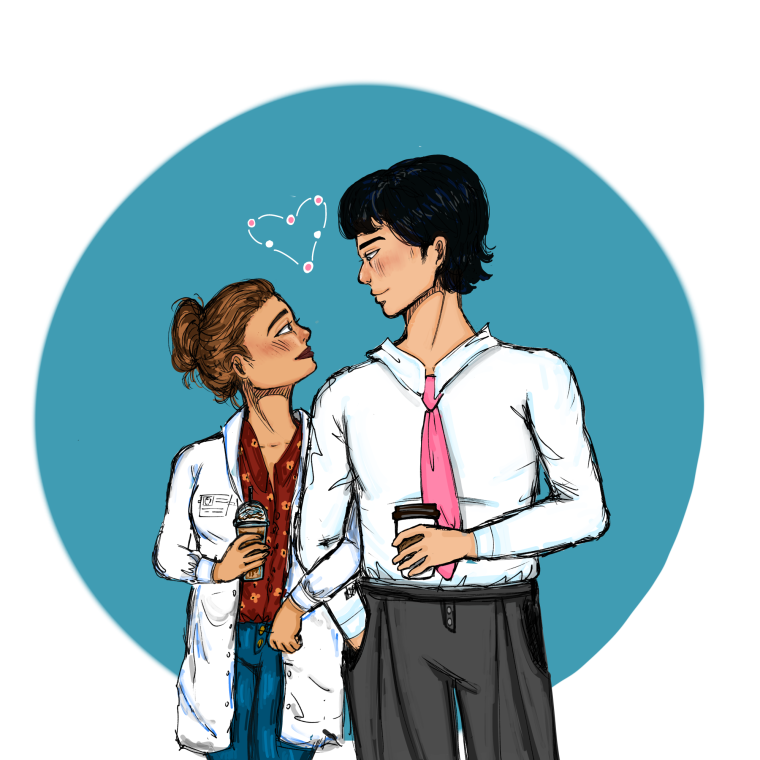
Additionally, “Her” has some of the most fully realized characters of his career. At the center of it all is Theodore (Joaquin Phoenix), who, yes, falls in love with Samantha (Scarlett Johansson), his operating system, towards the end of a divorce from his first wife. As their relationship deepens, Theodore and Samantha are forced to reckon with the implications of an intimate bond between man and machine.
Theodore could have been an outright freak clearly incapable of human interaction. It would have made the film’s work easier, allowing it to chart a clear progression from hermit to functioning member of society. But Jonze has more on his mind than that. He gives Theodore shades most filmmakers wouldn’t consider and makes us care about him from the film’s opening minutes. Yes, he’s a bit timid at times, but we can see how real people—both friends and romantic partners—would seek relationships with him.
Phoenix plays him with a similar depth. As he proved in “The Master,” he has a remarkable ability to immerse himself in offbeat roles and humanize them. By finding Theodore’s heart, Phoenix is able to justify the film’s intimate scope. This is show-don’t-tell acting of the first order, a performance that will surely garner Oscar love.
Johansson and Amy Adams (who plays Theodore’s friend Amy) are more than up to the task of matching Phoenix. Without a convincing vocal performance from Johansson, the film falls apart. Yet from the moment Theodore installs Samantha, her allure is clear. But she’s more than a lusty robo-girlfriend. Johansson sells the joys and difficulties of Samantha discovering her consciousness and seemingly limitless processing capabilities and makes them resonate with the same potency as Theodore’s successes and failures. As for Adams, well, there’s nothing I can say about her that she can’t say with her eyes, which contain multitudes that would have made her a silent film star had she been born half a century earlier.
Likewise, Jonze’s directorial instincts are in top form, even after a four-year hiatus. Part of the challenge of filmmaking is conveying complex ideas and emotions without resorting to clunky, didactic dialogue. Jonze accepts this challenge with no reservations, using visual and sonic detail to bring us into the hearts and minds of his characters. The film’s first scenes are a master class in world building, establishing both character and the social customs of a near-future story world in just 15 gorgeous minutes.
Similarly, his montages, which are some of the most elegant I’ve ever seen, compress Theodore’s entire relationship with his ex-wife into mere minutes without losing any context or emotional resonance. Jonze has never been one for narrative sprawl, but “Her” is his tightest, most succinct work yet. Never lingering on ideas or story beats more than necessary, he trusts his audience to keep up with him.
Cut to the rhythms of Theodore’s heart, there are long stretches of the film where every beat is nearly perfect. On multiple occasions I felt tears welling up, not from the film’s emotional content but due to the awe-inspiring harmony of sound and image. As impressive as the trailers might be, they simply can’t do justice to Jonze’s mastery of cinematic technique.
Perhaps “Her”’s most admirable quality is its complete lack of cynicism. The Internet is full of condescending philosophical pieces on technology’s corrosive effects, but Jonze never demonizes the machines at the heart of “Her”’s near-future society. They’re simply a fact of life, capable of tremendous good while simultaneously fraught with peril. We’re moving closer to a world where these kinds of relationships are a reality, and Jonze understands they’ll function as more than outlets for social misfits. Even the production design, with its soft colors and geometric minimalism, refuses to fall prey to the cold-hearted cynicism found in even the best science fiction films.
Never in a million years did I think Charlie Kaufman (the brilliant, enigmatic screenwriter behind Jonze’s first two features) and Dave Eggers (Jonze’s “Where The Wild Things Are” co-writer) would hold Jonze down, but “Her” fulfills untapped potential I didn’t know existed. Intimate, but never intrusive; tender, but never limp, Spike Jonze has made his masterpiece. Forget the cynics who say “Spring Breakers” is the film most emblematic of 2013. Much as they like to claim our generation is the most narcissistic and vapid, technology has not corrupted our souls. “Her” is proof.
Stay in Touch!
Get the latest and top news from StudentLife delivered to your inbox