Cadenza | Dance
‘Pathways’ adapts to virtual format by bringing new filming techniques to dance concert
Instead of a dark Edison Theatre and seats crowded with fellow audience members, this year, those who wanted to see the MFA Dance concert, “Pathways,” sat in the comfort of their homes and followed a link on the Performing Arts Department’s website to a Vimeo recording of the concert. That different format presented challenges—it’s hard, as an audience member, to be fully absorbed in the dance when there are so many external distractions that simply wouldn’t be present in a theater. But the show took advantage of its recorded format, playing with filming techniques to create an experience that simply couldn’t have existed in a normal year.
“Pathways” presented the works of this year’s three MFA dancers—Leah Robertson, Luewilla Smith-Barnett and Thomas Proctor. Robertson’s work “Vows of Melancholy” opened the show, her dance a stunning meditation on grief that built for nearly 40 minutes to its still uncertain conclusion. Opening with a single dancer in an empty room, Robertson’s dance embodied a sense of isolation. Cutting between locations, the dance switched between solitary dancers wearing muted colors—one in a darkened Edison Theatre, another in a bright space with wide windows and rough brick, another before white walls. These cuts, and the dance’s reuse of pieces of material, some being shown three times, gave the piece a kind of circularity, and flashes of dancers in the beginning firmly fixed my attention on those dancers when the film inevitably reached their section.
Occasionally, two or more dancers would share the screen. Their mirroring of each other’s movements, somehow both fluid and jerky, spoke of an echoed emotion and a desired connection that could never quite be achieved. Every time that connection appeared to be emerging, dancers would fall to the floor. One section, in which a dancer frantically scrubs at her hands as though trying to wash off some invisible stain, stuck with me long after the performance ended. That section truly encapsulates “Vows of Melancholy”—a longing to be free of something, to connect, and never quite getting there.
After the smooth style and film technique of Robertson’s piece came Smith-Barnett’s “The Sacred Value of Women,” which adapted to a virtual production in an entirely different way. This dance was broken up into several distinct sections. Each opened with excerpts of a speech or quotes from the Quran or various Muslim leaders emphasizing the power of women. The sections emphasized different elements of Muslim womanhood—the opening sections showed first a group of six women in brightly-colored traditional dresses. Five of the women stood around the woman in dark green, who knelt on a prayer mat. The second section, which too emphasized prayer, was where the dancing began—a woman in light green, kneeling in prayer position inside a mosque, began to dance with fluid and graceful motions that left no doubt this dance was one of devotion.
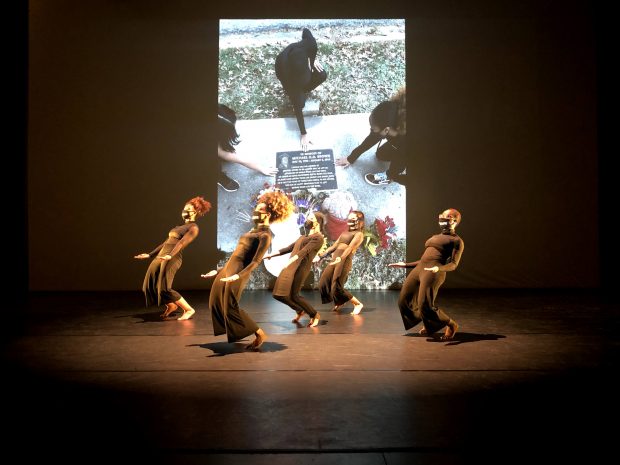
Each section—focusing on prayer, power, ferocity coexisting with mercy, motherly love, grief and more—presented beautiful costumes and intricate dancing. Often, though, I found myself getting lost in the pieces, losing concentration on the dance by being caught up in the words to which the piece was set. The sentiment of these pieces, about the necessity of empowering Black women and the oppression they have faced for centuries, captured me at the expense of the dance itself. I found myself faced with the choice to focus on the technical skill and beauty of the dance or on the words and message behind it, a choice I hated having to make. The two worked best during a section filmed in the Edison, with four dancers moving to a song by H.E.R. The piece ended with photos of killed Black men on a screen behind the dancers and H.E.R. saying “I couldn’t breathe.”
“The Sacred Value of Women” is both a protest and a demonstration of the way that compassion, tenderness, ferocity and religion can coexist in Black Muslim women even while the world attempts to push them down, and the different sections of the dance set in different locations worked, ultimately, to highlight these different but inextricable qualities.
The final piece, “Ubiquitous Plastic” by Thomas Proctor, came the closest to a dance that would be seen in a non-pandemic year. Entirely filmed on the Edison stage, the piece incorporated nearly a dozen dancers, the group filling the stage in a way none of us have seen in over a year. All dancers wore nude, skin-tight outfits, giving from a distance the impression that they wore no clothing. That nakedness only emphasized the piece’s props—from the beginning, when Proctor stood on a pile of leaves, slowly picking them up and crushing them, to the end, when dancers frantically threw plastic bottles onto different spots of a stage so packed with them that the rearranging made no difference.
Some dancers formed groups, dancing in robotic sync while others were alone, their white sashes slowly replaced with ones made of Schnucks grocery bags, which weighed them down until they could dance no more. A strange sense of hopelessness pervaded the piece; watching as all the white sashes changed color, as the immovable dancers were dragged offstage and as one dancer stood in the middle of the stage while dozens of plastic bottles were thrown at her from every angle. Technically, the piece was beautiful, only accentuated by the camera choices—especially the angle from the stage floor looking up with the bottles strewn around. I was captivated. But the piece did not build to a promising ending. When all dancers lined up and threw bottles at the camera/audience, I felt almost let down, and was deeply saddened by the true ending, where the majority of dancers walked out of Mallinckrodt, leaving a few stricken dancers unable to clean up the bottles they left behind.
Initially, I was skeptical of a virtual MFA Dance concert. But “Pathways,” despite being viewed in a bright room on my tiny laptop screen, shone. Each piece adapted to the challenges of virtual filming completely differently and in a way that brought attention to the emotion behind it, bringing truly enjoyable dance into our living rooms.
MFA Dance is streaming on the PAD website through April 11.
Read more reviews of pandemic-era performances:
Black Anthology embraces identity and community in the virtual age
‘FOCUS’ traps audiences inside their own heads (in a good way)
Stay in Touch!
Get the latest and top news from StudentLife delivered to your inbox