Administration
New focus committees look to address different facets of diversity
Campus leaders are progressing toward the formation of focus committees in the aftermath of the Feb. 26 incident in Bear’s Den that involved the use of a racial slur.
One committee will be tasked with establishing a system for students to report instances of bias and aggression, and another will investigate Washington University’s role in the domain of social media, according to former Student Union President Julian Nicks, who has been working with Vice Chancellor for Students Sharon Stahl and Vice Provost for Diversity Adrienne Davis.
The remaining committees will be disclosed in the coming weeks, with the idea being for one administrator or faculty member to oversee each committee.
“If it’s an area of trying to understand social media and social media responsibility, the people that focus on social media responsibility, like professors, are linked with respective students who wish to be involved with those issues,” Nicks said.
Social media resurfaced as an issue this past weekend, when an anonymous post on the “Wash U Confessions” Facebook page included the N-word. The page was taken down only to see a new “Wash U Confessions” created Sunday.
“What is our collective and individual responsibility when it comes to social media?” Davis said. “This is a new world for my generation…[Students] are the ones that really get it, so we have to collaborate together to figure out a way to practice community norms in social media that’s not censorious and it’s not violating people’s free speech rights, but it’s still respectful and emblematic of who we are as a community.”
Davis emphasized the importance of continued dialogue between all members of the University community and not just leaders of diversity groups.
“I know a lot of our Greek students are invested in and committed to diversity and trying to think through, ‘what is diversity in the context of Greek life? What role is there for Greek life to play in facilitating diversity?’” Davis said.
Stahl and Davis met often over spring break, and the two administrators have communicated with Nicks several times in person and several times per day through email.
Along with approximately 50 students, the three leaders also attended a March 18 meeting held by Chancellor Mark Wrighton to discuss the Bear’s Den incident, its fallout among students and reaction from the administration. About half the students at the meeting had made videos for the “Dear Chancellor Wrighton” Facebook campaign started by junior Camille Wright.
Leaders of campus diversity groups and two representatives each from the Interfraternity Council and Women’s Panhellenic Council were also present.
Wrighton started the meeting by addressing the importance of diversity and inclusion on campus, but he acted mostly as a listener for the next 90 minutes, several students in attendance told Student Life. During the meeting, attendees expressed their feelings of hurt resulting from the incident, their concerns over Wrighton’s delayed response—the chancellor sent out a University-wide email March 5—and recommendations for what to do next.
“We were clearing up some miscommunication, mostly because we don’t really know what the administration is doing, and then we got to hear their side—and it was nice to see a little more transparency,” senior Eunice Kwon, a member of Women’s Panhellenic Council, said.
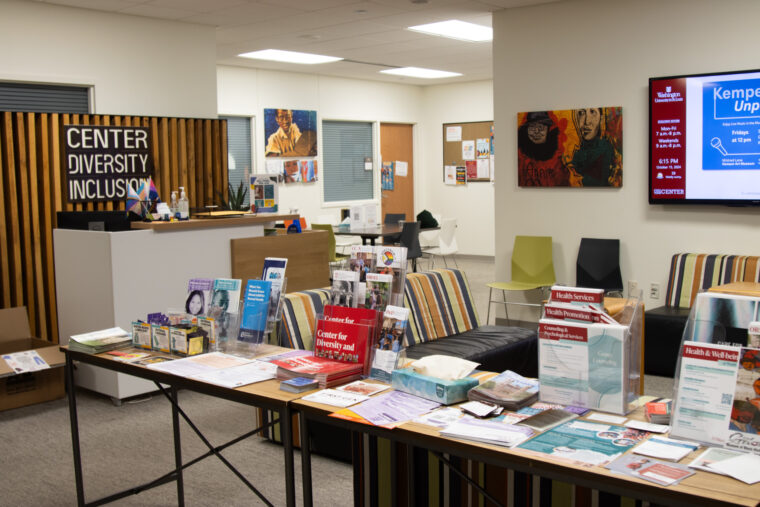
Student suggestions included the creation of a Diversity and Inclusion Center on campus and an improved diversity curriculum, whether through required academic coursework, freshman orientation programming like “The Date” or regular discussion groups.
Most students agreed that equipping students with a sufficient vocabulary to discuss race, class, gender and related issues is a needed step.
“If you go to these meetings and are involved with these student groups, you have a certain vocabulary of talking about privilege, oppression, marginalization, power dynamics, micro-aggressions and all these words that a lot of people aren’t familiar with,” sophomore Hana Hartman, who made a “Dear Chancellor Wrighton” video, told Student Life.
Sophomore June Jennings, who also submitted a video, pointed out that campus diversity can be tracked through statistics but inclusiveness cannot.
“Diversity is not an attitude—inclusiveness is,” Jennings said. “An institution can be very diverse but not inclusive.”
Jennings added that many students left the meeting disappointed that Wrighton did not speak more and answer questions more directly.
“I think he really wanted us to talk, but the reason we made the videos is because we wanted him to talk,” she said.
Wrighton was traveling at the time of Student Life’s interview request but provided input on the meeting via email.
“The students who met with me spoke eloquently about a wide range of issues that have disappointed, discouraged and frustrated them and others in this community, including me,” Wrighton wrote. “I especially appreciated the willingness of students to share their own specific and personal feelings, frustrations, and disappointments. I know that it is not always possible to meet the needs of those I serve, and I apologized to the group for not being as responsive as desired.”
Wrighton admitted that while he has difficulty fully understanding students’ feelings of hurt, he recognizes the gravity of the situation.
“For me, a significant conclusion from the discussion on March 18 is that we have not made as much progress as I would like in building a diverse and inclusive community,” Wrighton wrote. “I have to confess that I had thought we had made more progress than we have.”
Nick Miller, a doctoral student in English, fellow in the American Culture Studies department and faculty associate in Koenig House, came away from the meeting mostly satisfied with the Chancellor’s response.
“Looking back at it, the Chancellor did make the right decision in that he basically spent the majority of the meeting sitting and listening to people talk and took notes,” Miller said.
Miller, who teaches Writing I and a freshman seminar in Latino/a studies, suggested integrating aspects of cultural education into Writing I, although he said it would require additional training for most graduate instructors. Miller also called for firmer action from the administration.
“I feel like the administration at some point needs to make some sort of concrete statement about the incident itself but also remind the campus that it’s not just about the incident,” he said. “It’s also about the fact that there are students on campus who don’t necessarily feel safe—that there are instances of racism and micro-aggression that happen all the time.”
Stay in Touch!
Get the latest and top news from StudentLife delivered to your inbox