News
‘A project of public memory’: Journalist Nikole Hannah-Jones speaks on history, citizenship, and education
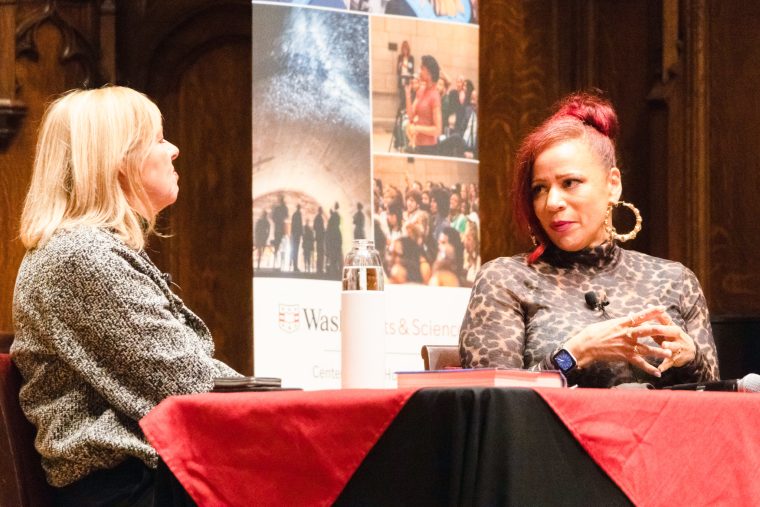
Nikole Hannah-Jones spoke about the legacy of slavery in the United States and other topics on Thursday (Millie Wolff | Staff Photographer)
Nikole Hannah-Jones reframed conceptions of American identity through the lens of racial inequity in her talk delivered at Graham Chapel on Thursday, Nov. 12. In the discussion with Stephanie Kirk, director of the Center for the Humanities, Hannah-Jones questioned modern perceptions of history, citizenship, and education to an audience of more than 300 people.
Hannah-Jones spoke on campus for the annual James E. McLeod Memorial Lecture on Higher Education and as part of the Sawyer Seminar Lecture Series on “Black Studies and the Future of the American University,” a yearlong 12-speaker series which brought Angela Davis to the University this past September. During her talk titled “Citizenship and the University,” which was also a part of the John C. Danforth Center on Religion and Politics series on the practice of citizenship, Hannah-Jones addressed the idea of citizenship in light of the country’s racial inequities.
“I’m not sure what citizenship can ever really mean in a country where Black folks were never supposed to be citizens,” she said.
Hannah-Jones is an investigative journalist who focuses on the African American experience. In 2020, she was awarded the Pulitzer Prize for her work on The 1619 Project, a long-form journalistic piece that examines enslavement’s lasting impact in America and works to create a more honest portrayal of the founding of the country.
When reflecting on The 1619 Project, Hannah-Jones defined it not as a history project, but as a work of public memory. The project and resulting book are named after the year 1619, when the first enslaved African was brought to America.
“It is a project of public memory,” Hannah-Jones said. “And it’s saying if we remember our country differently, we will understand our country as it is, not as a fiction, not as a myth, but as it is.”
She also recently garnered national attention for her piece in The New York Times titled “In Fighting for Every Black Child, Did I Betray My Own?” The article is a follow-up to a 2016 story where she explained her choice to enroll her daughter in a local, predominantly Black public school with high levels of poverty rather than to send her to an affluent school with more resources for its students.
Hannah-Jones responded to some critics of her choice after being asked about what she learned from her daughter’s educational experiences during the Q&A.
“When people condemn my choice to put my child in the Black community, what they were saying is they weren’t worried about the other 300 Black kids in that school who also did not get a quality education, they were mad that I was a traitor to my class and that I didn’t choose to leave my community like everyone else with an income like mine has,” she said.
In an interview following the event, Hannah-Jones told Student Life that justifying the educational decisions she made for her daughter was the “most personal” article she had ever written.
“The piece did what I hoped it would do, which was to reinvigorate discourse about school segregation and inequality,” she said. “That’s the power of journalism at its best and what it can do, but there’s a lot of great journalism that doesn’t break through as well.”
During the Q&A with Kirk in Graham Chapel, Hannah-Jones reflected on how our society sees education in general.
“Do we believe in education as a public good, or do we now believe in education as a consumer good? Where I take what I can get, and I don’t care about anybody else in my community,” Hannah-Jones said.
Hannah-Jones said American history, as it is taught to schoolchildren, is continuously framed in a way to ignore the wrongdoings of those in power. She added that history has been used as a tool of propaganda that lets systems of racial inequality function unchecked.
“Who gets to determine what we remember about our past and why? Because the why is essential,” Hannah-Jones said. “The first thing they did coming out of the gate in [Trump’s second term] on the very first day was … issue mandates about the teaching of history. …That’s because power gets its legitimacy from controlling how we think about the past.”
The 1619 Project reimagines history by centering enslavement as not incidental, but as the foundation of American society and democracy.
“We’ve been taught that slavery was incidental, was an asterisk, was marginal, was a couple of the backwards people in the South, a large group, was irrelevant,” Hannah-Jones said.
Instead, Hannah-Jones pointed out that many of the framers of the Constitution and 10 of the first 12 presidents were enslavers.
“There would be no America without African people enslaved,” she said. “There’s a power if you are Black of knowing that our lineage in this country predates the founding, that our lineage allows the founding.”
Hannah-Jones highlighted that a wholly positive narrative of American exceptionalism needs to be reframed.
“This country is exceptional in ways we should actually not be proud of. [It is] the most carceral nation in the world, one of the most biased nations in the world, one of the most economically unequal. Actually, the most economically unequal of the Western democracies in the world,” she added.
Following the talk, senior Mira Ugwuadu said that the lecture came at a challenging time for African and African American studies (AFAS). Last year, AFAS was one of six departments that WashU’s College of Arts & Sciences proposed to either reorganize or combine into one department.
“In these times [when] education and Black studies are being challenged, I thought that the lecture was a really great way to reshape the narrative and reshape perspective on American education,” they said.
Rebecca Amonor, an English graduate student, reflected on Hannah-Jones’ sentiment about the challenge and importance of sticking by your values when making difficult choices.
“It challenges the University to think about whether, when push comes to shove, we’re willing to stand by these values,” Amonor said.
At the end of the Q&A, Hannah-Jones told the audience that she believes the path forward is with younger generations.
“If there is a path out, it is going to be with our young people, and we need to stop talking down to them, stop disrespecting them, and actually help them to come into the leadership and liberation that they’re all trying to fight for,” she said.
Stay in Touch!
Get the latest and top news from StudentLife delivered to your inbox