Scene
WashU Dance Theatre’s ‘right now.’ shows us how to live in the present
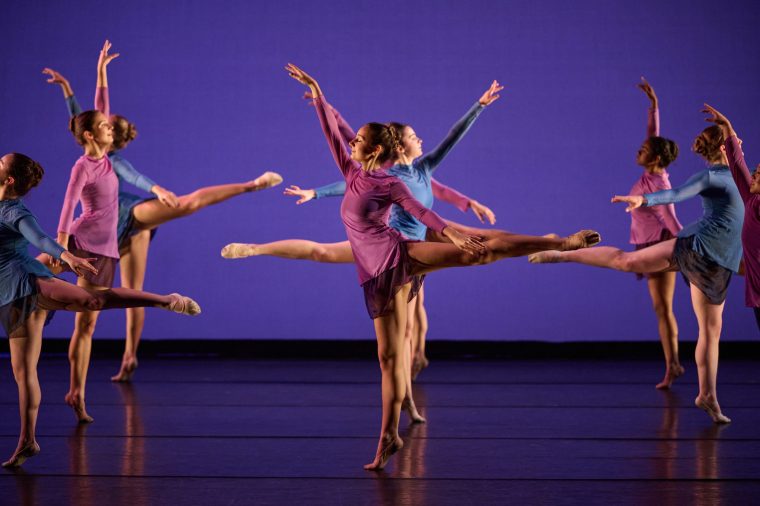
The fall Washington University Dance Theatre (WUDT) production “right now.” teaches the audience what it is to live and move in the moment. Under the artistic direction of David Marchant and choreographed by new Performing Arts Department (PAD) faculty member Liz Stillerman Anderson, MFA student Liz Lloyd, alumna Renée Austin, guest choreographer Shura Baryshnikov, and Lecturer in Dance Elinor Harrison, the pieces were all put together in collaboration with their dancers.
“Play it Again,” the second piece in the program, featured four dancers, moving and improvising to music playing from a record player on stage. A dancer approached and lifted the needle onto the record, and then the performance really commenced. The show’s unique lighting consisted of a little box of light that dancers slid and spun in and out freely. Junior Sydney Michelle Campusano, one of the four dancers featured in the piece, only began her dance journey at age 16 through her school’s winter guard. Now a more experienced dancer after two pieces with WUDT, she shared one of the most special parts of adding dance to her busy school schedule.
“You’re just doing what feels right for you and moving, and that’s what creates a beautiful piece because everybody has their own ‘right now,’” she said.
For Campusano, dance is an integral part of her academic and personal development.
“It’s like an academic release,” she said about including dance in a rigorous academic schedule, adding that it “really kept me balanced.”
Campusano partly attributed the show’s success to Harrison, who, besides choreographing a piece for WUDT, is also a faculty affiliate in the Philosophy-Neuroscience-Psychology (PNP) department and studies dance and the brain. Harrison’s piece, “I got it from my Mother,” defies the challenges of the residency model the department uses, in which each choreographer has about a week to fully put each dance together. With such a short time to assemble the choreography, the dancers “collaboratively generate movement with their choreographers,” Harrison said.
The dance was inspired by the music selection Harrison discovered, filled with quirky sounds, bells, and rhythms. Harrison came into rehearsals with general structures that allowed dancers to latch onto them really efficiently, creating a story about motherhood, lineage, and being a woman.
“I want it to be a big girl power dance by the end … a piece about women supporting women, and that bond and how we all hold each other up,” Harrison said.
The last piece, “A Dance For Eleven,” featured a large group of dancers working off what felt natural to their bodies, according to Campusano. Under the direction of Baryshnikov, the dancers expanded on their own improvisational movement and responded to those around them. Campusano raved about the experience of working with Baryshnikov.
“To her, none of us are experts or beginners,” Campusano said. “Everyone’s just a dancer right now, and you need to dance!”
The unique experiences of these dancers are exactly what excites Harrison about working on WUDT. For many years, she has seen her students graduate and explore different careers. Harrison is positive that the foundation they receive as dancers allows them to trust themselves and listen to themselves, which is imperative for every line of work. She embraces and admires the individuality of the dancers in WUDT, as well as the paths they forge for themselves.
“Our pieces only become richer because of people’s varied experiences. We don’t have cookie-cutter dancers here because everyone is coming from such varied places, and that is such a beautiful thing,” she said.
If not just a love letter to its dancers, the entire program is certainly an ode to the craft and what it can teach us about living in the moment, which Harrison hopes the audience will find on stage.
“We hope that you can see something of yourself in all of the dancing on stage, no matter where you’re coming from,” Harrison said.
Stay in Touch!
Get the latest and top news from StudentLife delivered to your inbox