News
The boiling frog effect: WashU’s AAUP chapter launches survey to identify ‘pain points’ for international scholars
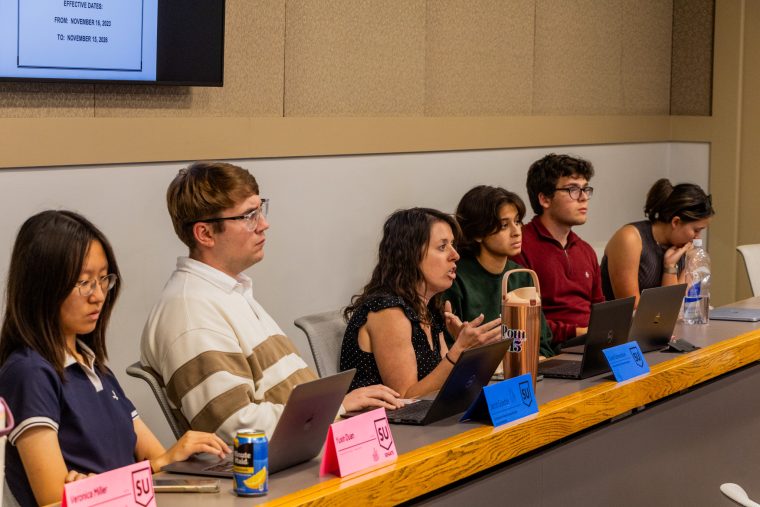
The AAUP hopes to present the data collected in its survey to the WashU administration. (Elizabeth Stump | Staff Writer)
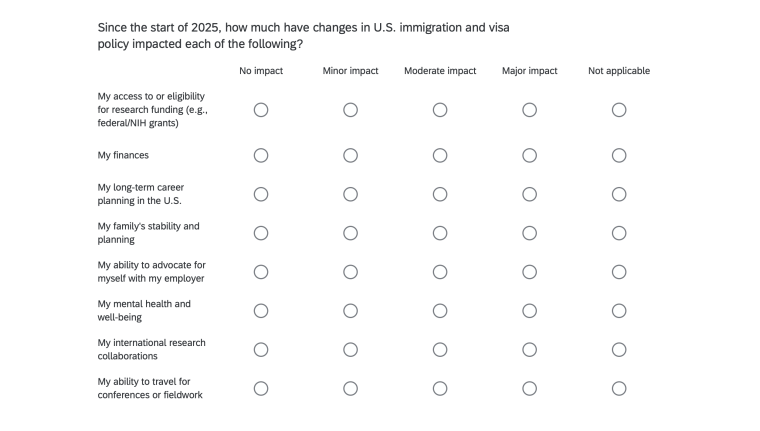
WashU’s chapter of the American Association of University Professors (AAUP) launched a survey to collect the concerns of non-citizen members of the University community. The survey is intended for international graduate students, PhD students, postdoctoral appointees (postdocs) and faculty along with residents and fellows at WashU’s School of Medicine.
The survey asks scholars questions about their comfortability travelling domestically and internationally, sharing political opinions on social media, and several other topics, according to Jacob Montgomery, a political science professor and chair of the AAUP committee distributing the questionnaire.
“Our goal is to better understand the pain points for international scholars here at WashU, and to think about what is reasonable to ask for, [so] that we can get more support from the university for our colleagues in these difficult times,” Montogomery said.
The survey, which is not intended for undergraduate international students, comes amid a host of federal changes to immigration and visa regulations.
One change recently proposed by the Department of Homeland Security (DHS) would limit the length of graduate study to four years with the option to apply for an extension, a change from their previous policy of “duration of status” which let scholars remain in the U.S. until completion of their program.
Although the DHS rule was blocked by a preliminary injunction by a federal judge the day it was scheduled to take effect, Montgomery notes that the constant changes to regulations have had a chilling effect on WashU’s international employees and students.
“I think it is really easy to overlook how stressed this population is because of the boiling frog effect,” Montgomery said. “It seems like they are changing rules or proposing new rules so often that I think the whole University community needs to be paying attention.”
The boiling frog effect refers to the scientific belief that a frog will jump out of a pot of boiling water, but will not notice or jump out if the pot is heated incrementally. Although the theory has been disproven, the metaphor is often used to refer to the tendency to ignore gradual changes in spite of devastating ramifications.
Montgomery acknowledged that while WashU does not have control over federal policies, he believes that there may be ways for the University to help international students.
“We can only do so much, but we should be working to do what we can,” he said.
Eight months ago, the University’s AAUP chapter formed a working group dedicated to advocating for international scholars amid the myriad of changes. The committee, termed the Working Group on International Scholars, is made up of a few PhD candidates and several professors from across WashU’s campuses. The group has conducted one-on-one interviews with several international scholars, but decided to conduct the survey to see if the concerns expressed in the meetings are broadly shared among international scholars.
The survey is not affiliated with the WashU administration nor the Office of International Students & Scholars (OISS). WashU’s Associate Vice Chancellor for University Communications Kedra Tolson declined to answer questions about the AAUP survey or the resources WashU currently offers international scholars. The OISS did not respond to similar questions as of publication.
As of the fourth week of this semester, 37.9% of WashU’s total graduate student population is reported to be international, around 5 percentage points lower than last year’s proportion. Notably, an even greater percent of WashU’s postdocs are of international origins — according to WashU’s postdoctoral website, almost 70% of WashU’s postdocs hail from outside of the U.S.. A third of WashU’s faculty members have international roots as well.
Montgomery noted that the goal of the survey is to identify broad concerns among the international scholar population as a whole, opposed to singling out individuals.
“We want to find out information and to advocate effectively without putting a target on the same population we’re trying to aid,” he said.
To that end, IP address and location tracking are turned off in the survey’s settings to ensure anonymous participation.
“We spent a lot of time thinking very carefully about what kinds of questions we wanted to ask that would guarantee that responses would be kept confidential,” Montgomery said. “We don’t ask for identifying information or even specifics of people’s immigration status. We don’t want to be in possession of that data.”
The working group plans to begin analyzing the data it does collect in November,with plans to compile it in a report to be shared with WashU administrators. Mongomery said they hope to synthesize commonly cited concerns while understanding that the challenges faced by international scholars will not be monolithic.
“[We are hoping to] start a productive conversation on what, if anything, WashU can do to help this vulnerable group of people navigate this difficult situation,” he said.
Stay in Touch!
Get the latest and top news from StudentLife delivered to your inbox