Professional Sports | Sports | Sports Feature
‘Control what you can control’: Lessons from Cardinals relief pitcher Gordon Graceffo
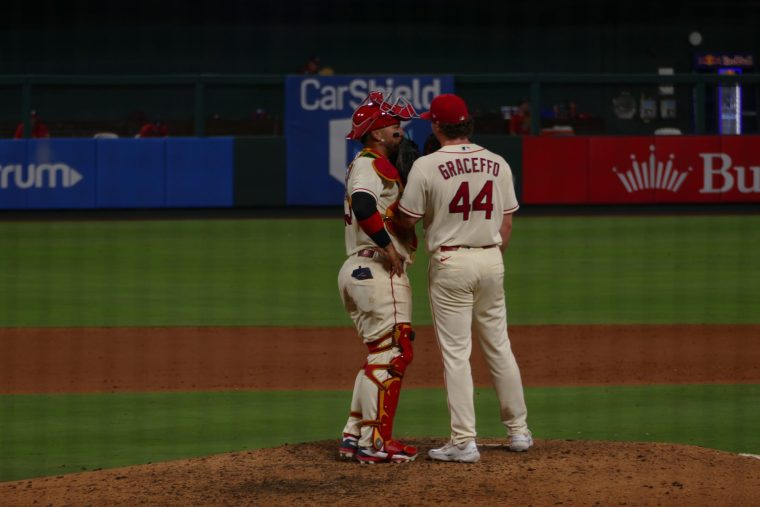
Cardinals relief pitcher Gordon Graceffo coordinates with the catcher on the mound (Sara Strassberg and Sara Gelrud | Staff Writer and Scene Editor)
Every student knows the feeling of a bad exam score or a paper that didn’t land. Cardinals relief pitcher Gordon Graceffo knows it too, except for him, the feeling manifests in front of thousands of people on a grassy field. If his story helps students understand anything, it’s that reaching one’s goals is dependent on a balance between hard work and a resilient mindset.
Graceffo has played in 62 games this season throwing a 2.67 ERA. His place in the majors was hard-earned: After the Cardinals drafted him in 2021, he worked his way up through the minor leagues from single-A to double-A to triple-A and finally made his major league debut in 2024. Since then, he has been sent down to triple-A and called back up three times. Now he’s back on the active roster, ready to be called from the bullpen.
Before being drafted into the MLB, Graceffo established himself as one of the most dominant pitchers in Villanova University’s history in just two full seasons, as his sophomore and junior seasons were interrupted by COVID.
He holds the Villanova single-season record for WHIP (walks plus hits per inning pitched) at 0.963, and his career WHIP of 1.193 ranks third in school history. WHIP measures how well a pitcher keeps runners off base, which is one of Graceffo’s main goals. Because it counts every baserunner rather than runs, WHIP paints a clearer picture of a pitcher’s individual command than ERA, with Graceffo’s 2.86 ERA ranking fourth in school history.
However, the stability Graceffo enjoyed as a start in college has given way to the uncertainty of life as a reliever for the Cardinals, much like a student who dominates in high school and arrives at college to find out that everyone else was at the top of their schools, too.
“At first you kind of feel like you kind of achieved this childhood dream of getting drafted and you enjoy that for a bit,” Graceffo said. “But then after about a week or so, it’s just time to get back to work.”
Whereas a starter can work through a rough first inning and adjust, a reliever often gets one chance to produce the outs he’s asked for. Graceffo navigates an irregular workload, high-leverage scenarios, unpredictable physical preparation, and the instant readiness that comes with his position. His current 2.67 ERA is proof he has adapted, but it hasn’t been easy, and it has required a mental approach that reaches past the mound.
“Going to the big leagues, it was a big difference because once they put me in the bullpen, it’s just a whole different mindset of ‘You’re not starting. You don’t have your own day,’” Graceffo said. “[As a starting pitcher], you don’t really worry about when you’re going to go in, or who you’re going to face.”
That shift in mindset reflects a structural divide in how the two roles operate. A starting pitcher operates on a predictable 5-day routine between outings to balance recovery, strength maintenance, and pitching preparation. A relief pitcher has no such schedule. He might be called on three days in a row or not at all for a week, and he often has to warm up in the bullpen without ever entering the game.
If the call does come, it’s usually in the middle of a tight game, sometimes with runners on base and no time to settle in. Graceffo’s last few outings of the season show how quickly that can go either way.
In the Cardinals’ 7-3 win against the White Sox on Friday, Sept. 11, Graceffo entered in the fifth inning with one out and a runner on first. In his short appearance, he struck out one batter, gave up a walk, and although he loaded the bases, he escaped the jam unscathed without allowing a single run.
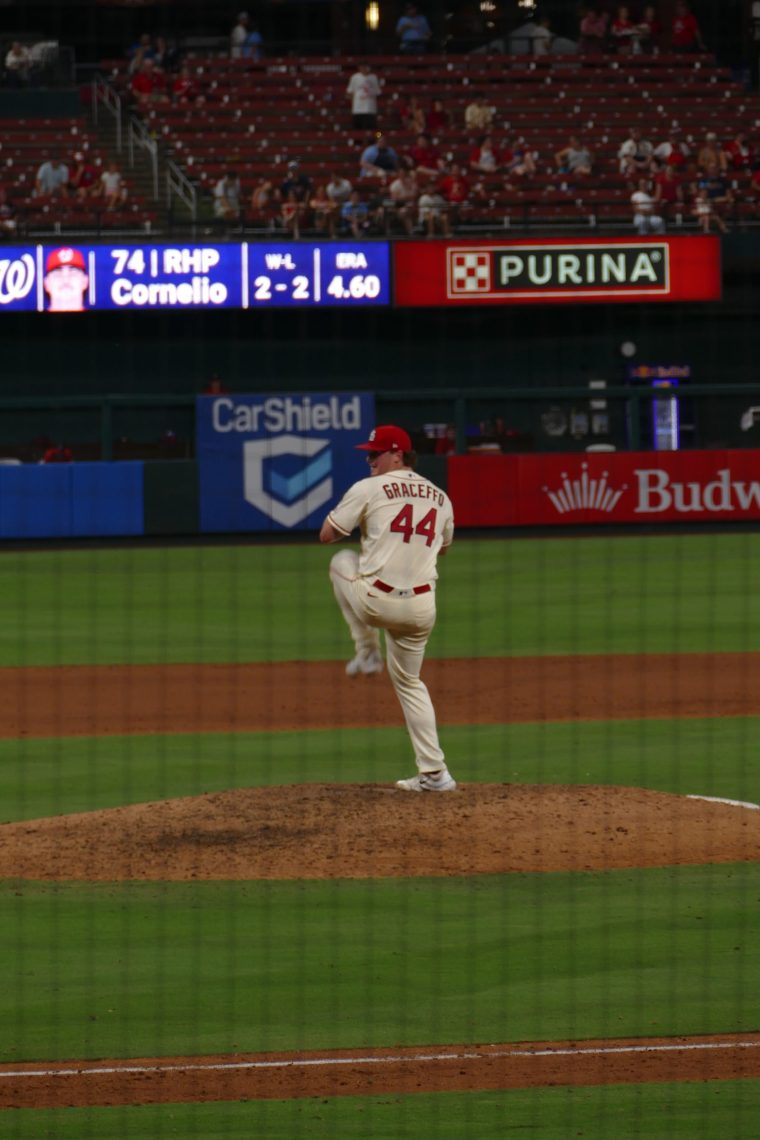
Gordon Graceffo entered the game in the 11th inning to pitch against the Washington Nationals. (Sara Strassberg and Sara Gelrud | Staff Writer and Scene Editor)
But in their 8-5 extra-innings loss to the Washington Nationals at home on Saturday, Sept. 19, things did not go as smoothly. Graceffo entered in the top of the 11th inning with the game tied at four and quickly loaded the bases after giving up a single and a walk. He never recovered, allowing four runs before getting the third out, and the Cardinals’ offense couldn’t respond in the bottom of the frame.
In games like these, when Graceffo is not playing at his best, he thinks back to what his dad taught him as a kid.
“One of his big sayings is ‘Control what you can control,’” Graceffo said.
That attitude is an important foundation for Graceffo’s performance, one that relies less on how much he trains and more on his mental fortitude. He knows that having a bad inning — like a student’s low exam score or paper grade –– is normal every so often, which is why he tries to move on by the time he throws the next pitch. In doing so, he is able to make the most of his opportunities when the coach subs him in.
Graceffo’s approach to the field isn’t just applicable to baseball or even restricted to a college campus. Anyone who has to perform under pressure, whether in a classroom, an office, or anywhere else, will eventually have their own version of a bad inning. What matters is what they do with the next pitch, and that’s a lesson worth carrying well past graduation.
Stay in Touch!
Get the latest and top news from StudentLife delivered to your inbox