News
WashU ends Faculty Fellows Program
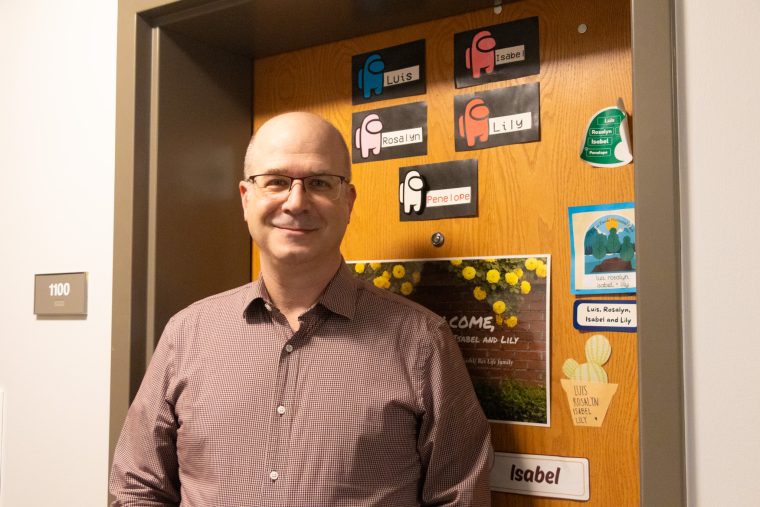
Luis Alejandro Salas, the faculty fellow for Umrath and Zetcher Houses (Seoha Kim | Contributing Photographer)
The Faculty Fellows Program, which placed faculty members in apartments in residential colleges, is being phased out due to “a significant inconsistency in residential engagement between residential communities,” Associate Vice Chancellor for Student Success Sheryl Mauricio told Student Life in an email.
The decision to sunset the program was made in 2023 by former Provost of Academic Affairs Beverly Wendland and “several members of the Student Success Division” according to Mauricio. The Faculty Fellows Program is part of the Office of Residential Life, which is under the Division of Student Success.
Three Faculty Fellows remain, including Lecturer in African and African American Studies El Hadji Samba Amadou Diallo, Associate Professor of Architecture and Urban Design Catalina Freixas, and Associate Professor of Classics Luis Alejandro Salas. The Residential Life community was informed of the ending of the program during a meeting on April 1, 2026.
One of the reasons Student Success provided for the program’s closure was due to questions with regard to with the program’s effectiveness, Salas wrote in an email to Student Life.
“Student Affairs [now Student Success] had determined that the Faculty Fellow Program did not offer sufficient quantifiable value to the university for Student Affairs to maintain it any longer,” Salas wrote.
Freixas said it didn’t seem like the decision was open for discussion.
“I wish that we could have known [before the meeting] so as to do more of a Q&A,” Freixas said. “But I mean, I think that the decision was already made, so there’s nothing that we can actually do.”
Mauricio said that Student Success intends to use the available space for additional units for student rooms. Salas added that Mauricio expanded on this in the meeting, and said that each Faculty Fellow residence could be converted into roughly five student beds.
Several members of the faculty doubt if this is a viable solution.
“The faculty department in Liggett-Koenig is completely isolated from the rest of the dorm,” Professor of English and former Faculty Fellow Anca Parvulescu said. “It would be odd to isolate three students there. … It’s not even feasible to put students there.”
Former and current Fellows called the program “transformative” and reflected on what future faculty members and students will miss out on.
Freixas said the relationships she built with students outlasted the one to two years they lived in the same residence.
“I consider myself the mom of 200 students,” she said. “I’m fortunate to have established a lot of very good [relationships] with a lot of them who are graduating this year.”
Freixas said that living in close proximity allows students and faculty to recognize one another as more similar than different — for example, in the laundry room.
“Actually, I have a washer and dryer in my unit, but I prefer to go to the laundry room because there are students [there], and then I can engage in conversation. I can offer them something to drink, some snacks. They have that vending machine, but my cookies are better.”
Arts & Sciences Vice Dean of Undergraduate Affairs Erin McGlothlin was the first Faculty Fellow to live in what is now Zetcher House from 2010 to 2013. During her years there, McGlothlin said she was very involved with students, setting up a sundae bar on Sundays, a graphic novel reading group, and a theater club.
McGlothlin described her time as a Faculty Fellow as a turning point in her life as a faculty member.
“I really started to understand holistically how students live their lives,” she said. “I wasn’t just encountering them in the classroom. Coming out of that experience was why I decided I wanted to start an Ampersand program.”
McGlothlin also saw how the students benefited from seeing a professor outside the classroom.
“I think for students it humanizes the faculty a little bit, and it bridged the academic and residential side. It was an example of a really beneficial collaboration between the academic side and this now what we call the Student Success side, and unfortunately, not many of those collaborations exist anymore.”
Professor at the Bursky School of Public Health Joe Steensma recently completed his last of four years as a Faculty Fellow in the William Greenleaf Eliot Residential College.
“Being a faculty fellow was the greatest honor of my professional career. … No other honor or professional accomplishment is remotely close. I will be eternally grateful to Washington University for allowing me to serve in this unique capacity,” he wrote in an email to Student Life. “I hope Kristie (my wife) and I modeled what scholarship and citizenship look like in a community striving to be more curious and kind in a world that has increasingly become intransigent and callous.”
Professor of Philosophy Kit Wellman, who was a Faculty Fellow in Umrath House from 2013 to 2017, agreed that the program changed how he interacted with students in the classroom.
“Whenever a student needs an extension, I am much more open to it, and I try to emphasize that the schoolwork is secondary, and that they need to take care of themselves first and foremost. I think that I always try to see them as people rather than just as students,” Wellman said.
Professor of French and Comparative Literature Tili Boon Cuillé was a Faculty Fellow from 2005, when her daughter was nine months old, until 2008, when her son was nine months old.
The Faculty Fellows Program was something that set WashU apart from other institutions, she said, and was modeled after “aspirational peer institutions” like Rice University and Princeton University.
“I think that [Faculty Fellows are] a lot of what made WashU able to lay claim to offering a school that’s very strong in the sciences and in many ways is strong in preprofessional training also offers a liberal arts feel, keeping the larger campus more intimate and allowing the professor to kind of individually tailor their classes or their interactions to student needs,” Cuillé said. “I think that there’s a risk that some of that would be sacrificed, and I really think that that’s what makes WashU kind of unique as an institution of its size and its status.”
Stay in Touch!
Get the latest and top news from StudentLife delivered to your inbox