News
Professors push back on humanities report at widely attended forum
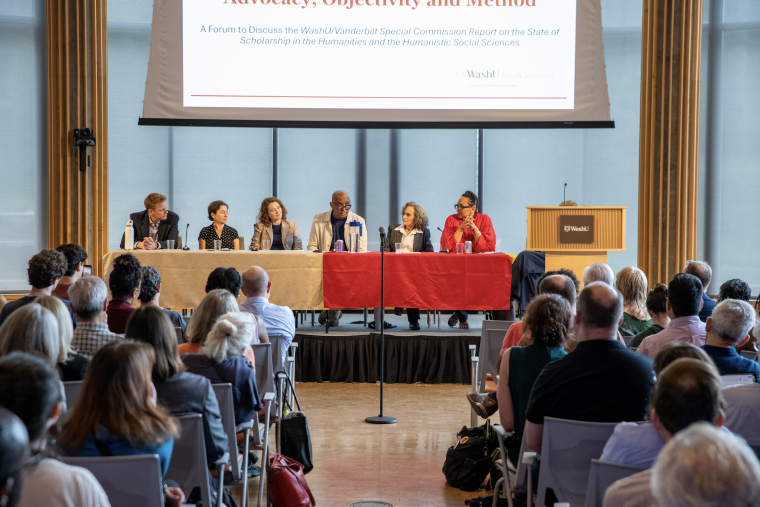
WashU faculty members discuss a report on the validity of humanistic research in the presence of WashU community members and University leadership (courtesy of Phillip Hamer)
Six WashU faculty members critiqued a report commissioned by WashU and Vanderbilt on the politicization of the humanities in front of approximately 200 in-person students, faculty, and WashU community members, as well as 81 more watching virtually. The event was hosted by the Center for the Humanities on Sept. 16.
In June, a committee of scholars funded by WashU and Vanderbilt published a report on the state of the humanities and humanistic social sciences which found that research in many humanistic fields are politically driven. The report generated national criticism, and many WashU professors raised questions about what WashU’s role in the report was, what the report meant for humanities funding, and more.
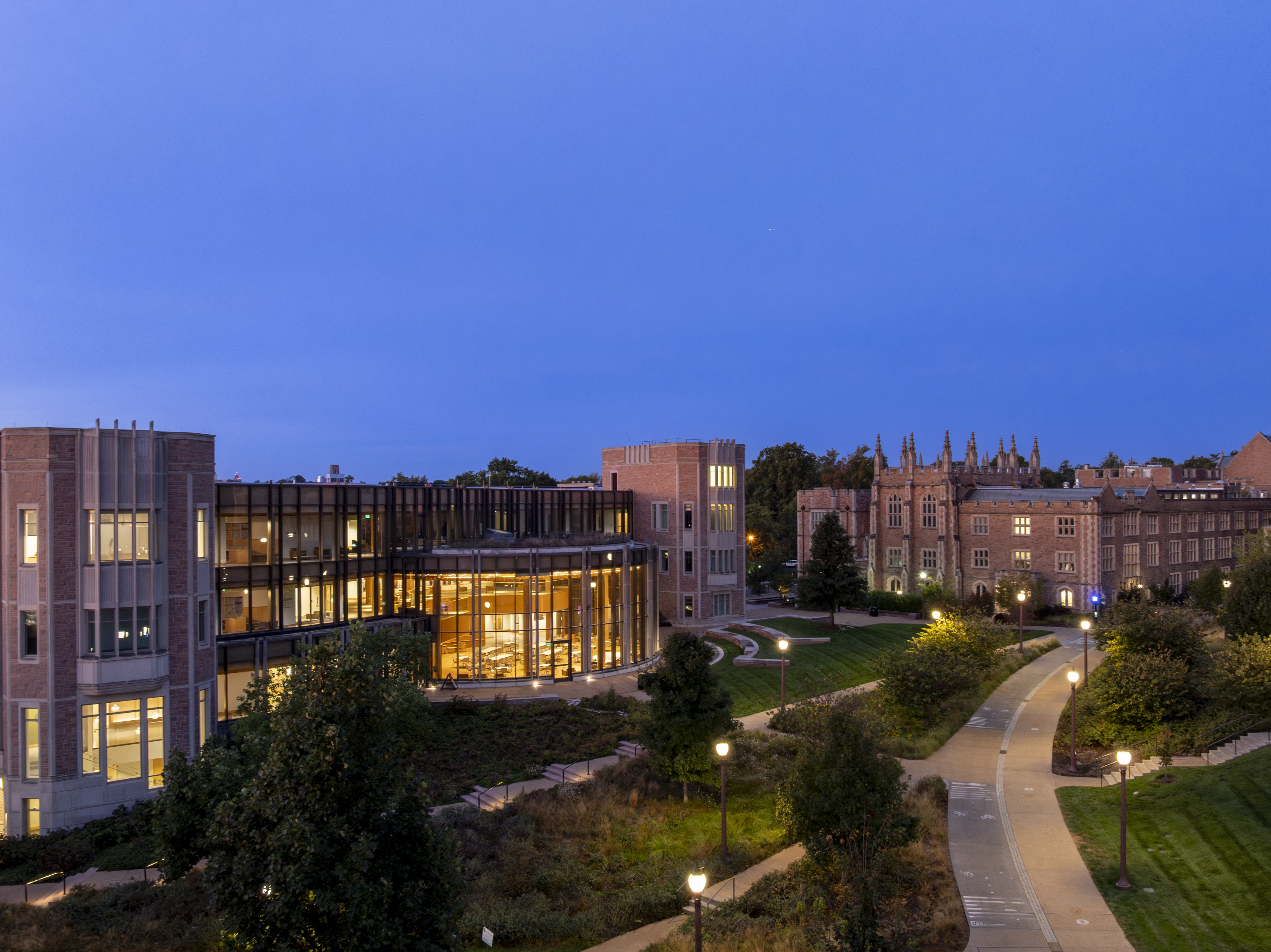
After the report’s release, Director of the Center for the Humanities Stephanie Kirk worked with colleagues within the humanities as well as the provost’s office to plan the forum, which was titled “Advocacy, Objectivity, and Method” and hosted in Hillman Hall. The panelists were Professor of Law Adrienne Davis, Professor of Sociocultural Anthropology Rebecca Lester, Professor of African & African American Studies Dwight McBride, Chair of Women, Gender, and Sexuality Studies Diana O’Brien, Chair of the Department of History Corinna Treitel, and Director of the John C. Danforth Center on Religion and Politics Abram Van Engen.
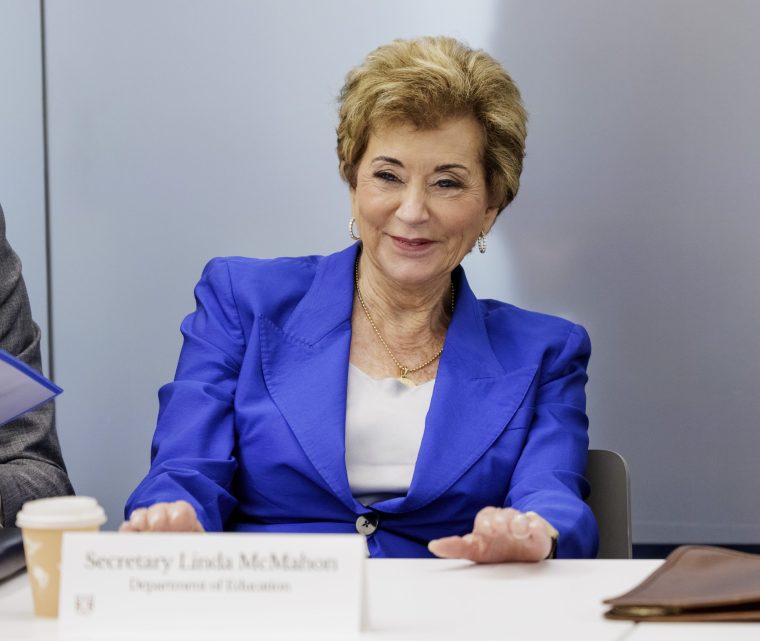
Provost Mark D. West, Dean Feng Sheng Hu, and Chancellor Andrew D. Martin were all scheduled to attend the event, but at the last minute, it was announced that Martin was unable to come. Martin’s absence coincided with a visit from Secretary of Education Linda McMahon. According to West, Martin was upset that he could not be there.
“He will watch [the recording]. He will listen,” West said.
The panelists critiqued the report as singling out the humanities when all fields engage in similar research, called for a more thorough investigation into its claims, and presented new empirical research on the topic.
“If it had been submitted for peer review, it would have been sent back or just plain rejected, because [lead author Paul] Boghossian refuses to engage relevant sources or address serious arguments that are opposed to his own,” Van Engen said.
In opening remarks, West emphasized that there are no plans to take specific actions based on the report, “other than discussions like this one.”
Davis questioned why the humanities were singled out in the report, noting how nearly every school at WashU, undergraduate and graduate, engages in promoting social justice and combatting institutional racism.
“Health inequity disparities, lack of diversity, urban racial segregation, structural racial discrimination — each of which is taken as an a priori societal ill to be addressed — are seemingly proper objects of study, research, and at times advocacy across much of Washington University’s vast research enterprise, and yet for my colleagues in the humanities, the report casts the same a priori assumptions as suspect and outside the bounds of appropriate and appropriately rigorous scholarship,” Davis said.
Additionally, Davis said that other professional schools draw on the vocabularies developed by humanists such as the concept of intersectionality.
“Kimberlé Crenshaw’s framework of intersectionality is not only one of the most cited and influential ideas in legal scholarship, but one that has been embraced as a definitive framework in countless academic fields and disciplines and has transcended the academy into the broader world of policy and corporate America,” Davis said, emphasizing that Crenshaw’s work drew on humanist scholarship.
After Davis’ acknowledgement of the interdisciplinary research done in fields outside the humanities, Lester added that research has always been molded by political forces, a discovery made within the humanistic community.
“Political ideology does shape academic knowledge and the standards by which it’s evaluated. … This is not a new idea. Humanists and social scientists have been making precisely this point for decades. It’s actually cause for celebration, I think, that this has finally broken through into the public discourse.”
However, the report does not make a conclusion but rather proposes a hypothesis, one which Lester would like to see researched more in depth.
“Let’s do what a world-class research institution like Washington University does best. Let’s investigate it according to the highest standard of scholarship,” Lester said.
She then explained the process that a research project like this would require: Identifying study samples, looking at funding and donors, and other quantitative methods.
“This hypothesis requires qualitative depth — the kind of careful, contextual, interpretive work necessary for investigating which scholarly standards are applied by whom, to whom, in what contexts, and with what implications,” she said.
She also said that in order for the report to be more rigorous, its authors should have been more transparent about funding and the interests of those writing it.
“A study of political influence on scholarly standards that isn’t transparent about its own political location is, at minimum, incomplete,” she said.
Lester concluded her speech with a call to Martin.
“I ask you, Chancellor Martin, when you watch this, not to denounce this report, but to stand by it, stand by its stated concerns about the influence of political ideology on scholarly standards, take its provocations seriously, and leverage WashU’s well-earned reputation as a world-class research university to initiate a rigorous, transparent, interdisciplinary, and independent investigation of these issues across the entire academy,” Lester said.
Following Lester’s speech, McBride asked: “What if at least some of what the report identifies as the politicization of scholarship actually reflects the diversification of the academy itself?”
“Black studies, women’s studies, ethnic studies, postcolonial studies, queer studies, and critical scholarship on race, gender, and equality did not abandon scholarly rigor. Scholars built those fields, and in significant measure, because they began asking questions that established disciplines and institutions had previously failed or refused to ask,” McBride said.
Although the report’s authors acknowledge the potential political use of the report, that threat is no longer hypothetical, McBride said.
“On August 3rd, Secretary of Education Linda McMahon issued a national call to action to university presidents and governing boards. In it, she praises this very report as one of the ‘courageous documents’ demonstrating the need for what she calls ‘essential reforms’ of higher American education,” he continued.
O’Brien approached the report from an empirical standpoint and looked into whether research in the humanities lowered public trust in universities. As a scholar of political science, she conducted her own research with 800 participants from across the country after the report came out. She found there was no increase in trust in higher education when humanities oversight increased. A few things that lowered trust were expanding artificial intelligence on campus and closing gender studies programs.
Treitel spoke to her first-hand experience of the rigorous work done by humanities and humanistic social sciences professors at WashU. She also called for several more reports on topics like research funding, AI, graduate training, and interdisciplinary collaboration, garnering laughter from the audience.
Lastly, Van Engen talked about the importance of self-examination when conducting research and Boghossian’s lack thereof.
“[Boghossian] allowed very little input from others, and mainly used the opportunity, it seems, to promote his own book. So that’s why I call it ‘The Boghossian Report,’” Van Engen said. “To someone with a hammer, everything is a nail, and to someone who wrote a book on objectivity, everything is a problem of relativism.”
After the lightning talks, students and faculty members lined up at a microphone to ask questions or make comments about the report and the panelists’ speeches. However, many of the questions were directed at administrators, and while West and Hu listened to each, they did not respond to questions.
Sophomore Alandee Patil was curious as to whether there were people at WashU who agreed with the report.
“We’re such a huge school, and I would love to understand more about if there is an imbalance in perspectives responding to the report, why is that? Or if there isn’t, I would love to hear more about the other perspective,” Patil said after the panel.
Senior Justice Crandall attended the forum with a women, gender, and sexuality studies class, From Decolonization to Globalization.
“I hope that we have a future where we can see academic freedom and freedom of political expression at a wider scale in the country and specifically on college campuses. This report is not something that stands alone. It comes in a greater context of attacks on personal freedoms. … Hopefully, it won’t have to last too much longer,” Crandall said.
Editors Note: This story was changed at 12:39 September 22 to reflect that Davis said “a priori” not “a priority,” when referring to social issues that are subjects of research and that Kimberlé Crenshaw’s work drew on humanist scholarship, but she was not a humanist herself. It was updated again on 2:15 p.m. on September 23 to add more context to Lester’s comments directed to Martin.
Stay in Touch!
Get the latest and top news from StudentLife delivered to your inbox