Club Sports
Sailing team finds success amidst unique circumstances
The Washington University club sailing team practices 600 miles from the nearest ocean, but on June 1 and 2 the Bears finished 16th of 18 in the semifinals of the Gill College Sailing Coed National Championships, the premiere collegiate sailing regatta of the season. Held in Newport, R.I., the field featured a vast majority of teams from the quintessential Eastern maritime schools. Pitted against such entrenched programs, sophomore Nathan Ross, who skippered one of the two boats in the Wash. U. fleet, felt the gravity of the competition.
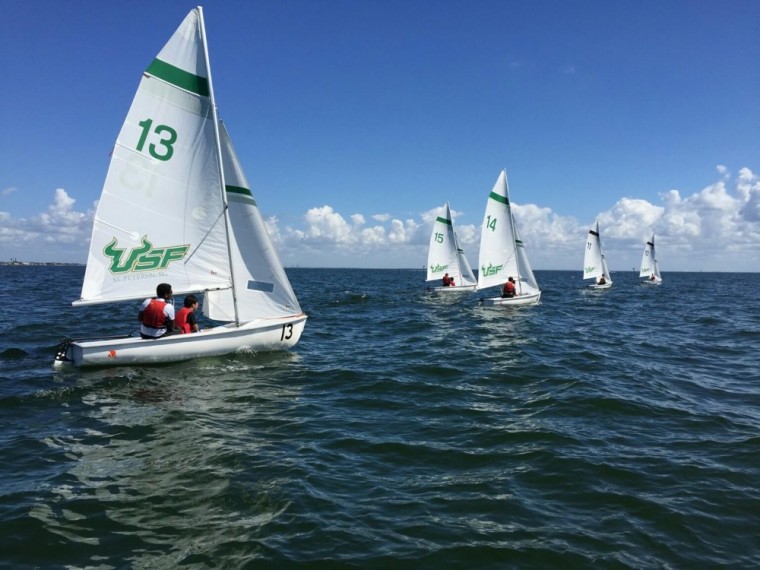 Courtesy of Theodore Cohen
 The sailing team took a spring break training trip where they chartered boats from the University of South Florida. Here, the sailors are training to sail upwind.
“You definitely feel a little intimidated because the other teams that usually make nationals are other teams like Harvard, Boston College, Georgetown,” Ross said. “People with giant sailing funds and professional coaches who’ve made the Olympics.”
By comparison, the Bears do not even have a coach.
To qualify for nationals, the Bears needed to earn a top-five spot in the Midwest Collegiate Sailing Association (MCSA) Coed Championship. The Bears finished fourth behind the University of Wisconsin-Madison, the University of Michigan and the University of Minnesota.
At nationals each team sends two doublehanded boat crews to compete in the semifinals. The Bears sent junior James Harvey and Ross to skipper an “A” boat and a “B” boat respectively. Ross sailed with senior Ted Cohen while Harvey’s was crewed by Russell Melin, who left Wash. U. following the 2015 season to pursue a career in commercial sailing. Each boat sailed against the opposing teams “A” and “B” fleets.
The regatta itself is simple. All 18 boats in the field jockey for position at the starting line until a three-minute countdown signals the start of the race. From there the boats must tack upwind and around a buoy. From there it’s a dead sprint back to the starting line for the finish. Depending on the weather conditions the race can take anywhere from 25 to 40 minutes. Each team’s boats must race 15 times in the semifinals over the course of two days. Adding to the difficulty, the weather hovered in the low 50s and the fleets were buffeted by 20-miles-an-hour winds. Even Ross, a seasoned sailor by Wash. U. standards, was fatigued by the schedule
“James and I each skippered I think eight to 10 races the first day, which was just grueling. So like 8 a.m. to 6 p.m. we are out there on the water,” Ross said.
An often-overlooked aspect of collegiate sailing is the necessary physical endurance.
Sailors operate various models of dinghies that, while maneuverable, are easily tipped by the wind.
“In a heavier breeze, you need to be leaning out of the boat as far as you can,” Cohen said. “That’s called hiking out, and if it’s a particularly breezy day, you need to be doing that for literally the entire race, which is an incredible core workout—it’s really hard on the legs.”
Cohen noted that the team’s lack of physical endurance was exposed at nationals.
“We did find that we were not as in shape as some of the other teams competing at the regatta,” Cohen said.
While the Bears did not fare well overall, the B fleet did finish 4th in a pair of races, beating out boats from the College of Charleston and Georgetown.
As one would expect, much of the Bears’ troubles lie with geography. The team currently practices on Carlyle Lake in Illinois, an hour-and-15-minute drive east of the University. As a result, it is infeasible for the team to practice more than twice a week if they are lucky. By comparison, the Northeast programs practice six times a week.
When the Bears do get to the water, their practices are fairly informal. For many members of the team who have only had cursory experience sailing, practice is more about getting a handle on the basics. Time permitting, some of the more seasoned sailors will run drills to prepare for regattas.
Since each program only needs four sailors to qualify for the national regattas, the Bears are buoyed by the experience of their core members. Ross was pushed to pick up sailing at an early age by his father who also sailed competitively. His grandparents owned a maritime distributor and his house was minutes away from the local yacht club on the shores of Lake Ontario. He was a founding member of his high school sailing club that went on to win the state championships a few years later. That success propelled him to compete at other national championships, even going on to represent the U.S. in a junior world’s campaign. He considered joining the Dartmouth varsity sailing team before arriving at Wash. U.
Harvey also began to sail competitively in high school after his dad, who was on the Canadian national team, introduced him to the sport. Before the Bears made waves at doublehanded nationals Harvey finished 10 out of 18 in the singlehanded nationals on Nov. 9, 2014 at Western Washington University, beating out teams from Stanford University and College of Charleston. To qualify for that regatta, he dominated at the Midwest level, winning all 10 of his races in his own boat that he brought to school.
Rounding out the three is Cohen, who took up sailing seriously at the age of 10 when he went to a YMCA sailing sleep-away camp in Wakefield, R.I. He was a camper for six years and has worked as a staff member for the past five years.
Without a heavy maritime tradition in the area, the Bears rely on partial funding from the Wash. U. Sports Club Board, $30 per semester dues and intermittent donations from team alumni. Even so, Wash. U. sailing falls in a different economic class than its East-coast peers.
The Bears currently have two Club 420s and three Flying Juniors in the fleet, plus one Laser, a single-handed dinghy that Harvey brought from home. As the cost of a new 420 is around $8,000, all of the boats in the Bears’ fleet average around 15-years old. The boats are well maintained, but algae growth, frayed ropes and rusted pulleys can still hamper sailing.
At the national semifinals, each team was provided with a new model of Club 420 called the Z420 in an attempt to level the playing field.
The Bears realize it is difficult for them to compete with the wealth and allure of other programs; however, they are focused on developing their talent with the resources on hand.
“We have a bit of an idea now, of what they are doing a little bit differently, but we need to be able to start getting into that mentality of, ‘They aren’t untouchable,’” Ross said.
Part of that will be greater discipline in practice time.
“What I want to try and start doing is organizing set pairs of two people…to go out on some of these practice days and all day just train against each other to get ready for those bigger regattas,” Ross said. “Because all of last year we didn’t really have practice for [Harvey] or I. It was more of a ‘get people exposed to the club,’ which I think is great, but I think we also need to start getting into the racing mentality.”
This new sense of purpose will be on display from Sept. 19 to 20 at the Harkin Clinic hosted by Northwestern University.
Stay in Touch!
Get the latest and top news from StudentLife delivered to your inbox