Professional Sports | Sports
NIL is ruining college sports
(Anna Dorsey | Illustration Editor)
On Saturday, Jan. 19, ahead of the 2026 College Football Playoff National Championship game, University of Miami quarterback Carson Beck made a stunning admission. Beck, who is in his sixth season of college football, including his redshirt freshman year, was asked by a reporter if he had class on Friday ahead of Miami’s matchup against Indiana University on Monday. In response, Beck said that he had graduated from college two years ago.
The Miami QB, who was in the same 2020 high school recruiting class as third-year NFL pros C.J. Stroud and Bryce Young, is just one of many byproducts of the current college football environment; one where transfers, extra eligibility, and graduate years have become all the rage.
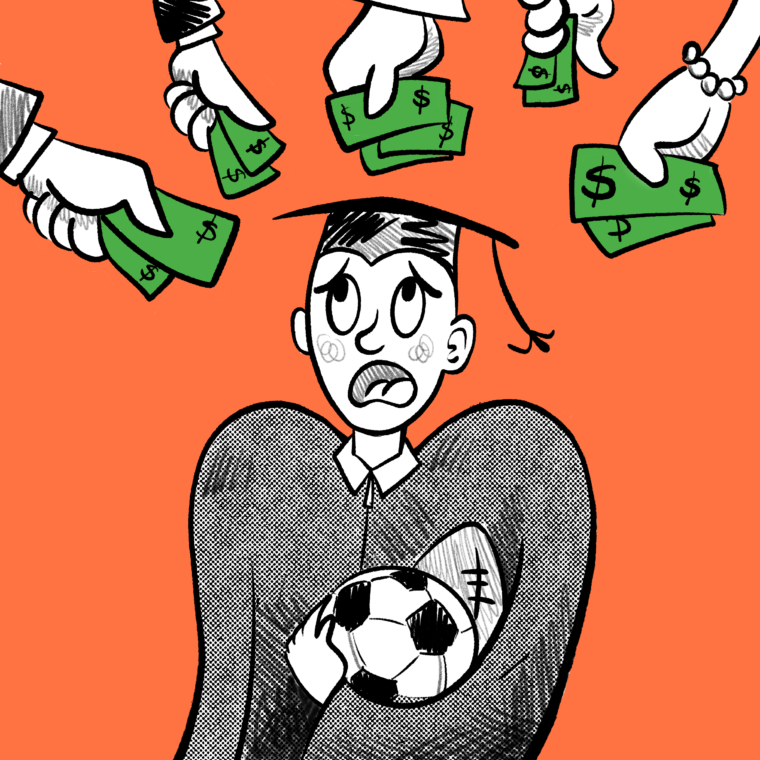
NIL (Name, Image, and Likeness), the recently enacted system of student athlete compensation, was supposed to fix college sports. After decades of universities making millions off of athletes, NIL was meant to level the playing field. Instead, it has ushered in an era of player mobility that has turned college football, basketball, and other sports into a transfer free-for-all.
Under the current system, schools cannot directly pay an athlete to transfer to their program like the free agency system in professional sports. However, booster-funded NIL funds work adjacent to schools and effectively serve as the financial arm for teams on the transfer portal. This gives schools with more donors (see: Mark Cuban’s contributions to Indiana University football) an overpowering advantage in recruiting players through the transfer portal.
At this point, it is not an exaggeration to say there is more player mobility in college football than in the NFL. This season, 14 of the national champion Indiana Hoosiers’ 22 starters, as well as their starting punter and long snapper, started their college careers elsewhere before transferring to Indiana. In comparison, the 2025 Super Bowl champion Philadelphia Eagles drafted a majority of their roster and acquired just eight of their starters from other teams via free agent signing or trades.
After all, there are too many instances to count of NIL deals luring players from school to school, looking to extend their college careers to profit as much as possible. Take Beck, for example. After five years at the University of Georgia, Beck was lured to Miami by an estimated $4 million NIL package. Including Beck’s brand endorsements and other partnerships, there is a large chance he is making more money this year as a “student” than if he had been drafted into the NFL as a backup QB.
Or look at Chad Baker-Mazara, a University of Southern California “super senior” currently playing his sixth season of college basketball. The sixth-year athlete will finish his college career at the ripe age of 26, and is nearly a year older than six-year NBA vets Anthony Edwards and Tyrese Maxey. Baker-Mazara started at Duquesne University before transferring to San Diego State University for his sophomore year, then transferred to Northwest Florida State College for his junior year, then spent two years at Auburn University. He notably entered the transfer portal for the fifth time last summer after learning his offered $1.1 million NIL deal was half of what another recruit was set to receive.
And I would be remiss if I didn’t mention quarterback Darian Mensah, who is currently being sued by his (current? former?) alma mater, Duke University, for violating an exclusive NIL deal by seeking to enter the transfer portal. Duke recently requested a temporary restraining order before they could enter an arbitration hearing with Mensah. Boosters at Miami, which is trying to lure Mensah away from Duke, are offering Mensah $10 million, a higher salary than two of the four quarterbacks set to start in NFL conference championship games. Miami is also offering Mensah’s sister Grace, a midfielder on the University of Oregon women’s soccer team, a full-ride scholarship to play for Miami with NIL benefits of her own.
Clearly, cases like these are bad for the integrity of college sports. While not every instance of NIL-driven movement is as egregious as the aforementioned three, each one reinforces a precedent that undermines the foundation of college athletics.
It would be naive to suggest that academics are the primary motivator for a college choice among the majority of top athletes. Still, a coherent university experience has been, and should continue to be, integral for college athletes. Short-term contracts, roster churn, and financial leverage created by NIL are antithetical to this fundamental principle of the NCAA.
Player compensation is not the enemy — high-level college athletes arguably should receive compensation for their services that bring in millions of dollars to their universities. But the current system must be reformed. Without guardrails, college sports will continue drifting towards becoming a true professional league, but one without the financial structures and regulations that govern the NBA, NFL, MLB, and other leagues.
Further, the NCAA should seriously consider taking action to limit transfers and post-graduation years. In an ideal world, athletes should spend at least two years at a university they transfer to and be limited to a maximum of four or five years of eligibility. Any such amendment will inevitably be met with litigation and court challenges, but facing opposition is imperative to the long-term success of college sports.
If the NCAA doesn’t act, what will the future of college athletics look like? Seventh, eighth and ninth-year seniors? Eight-figure NIL contracts? Financial juggernauts dominating each sport, with Cinderella runs and team chemistry replaced by superteams?
Failure to intervene will result in the slow death of the college sports atmosphere we have grown to love. And nothing will be more responsible than the current NIL system.
Stay in Touch!
Get the latest and top news from StudentLife delivered to your inbox