Club Sports | Sports
‘Not just a fad’: WashU’s pickleball club forms competitive branch
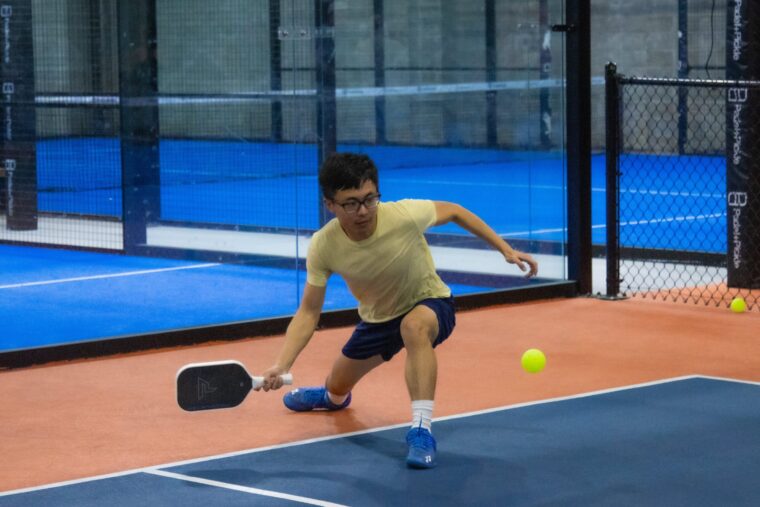
Law student Barry Zhang rallies at a club pickleball practice. (Ella Giere | Staff Photographer)
WashU Club Pickleball has recently formed a competitive branch that aims to compete in collegiate pickleball tournaments later this year. The tryouts for the competitive team attracted over 80 students, from which seven female and seven male players were selected by the seven-member executive team.
Pickleball has been gaining popularity among WashU students in recent years, and the pickleball GroupMe chat now boasts 484 members. However, first-year Noe Schwartz — competitive branch co-vice president and co-captain — estimated the number of active members to be around 150.
Senior Justin Xu, an avid pickleball player, is a co-president of the competitive branch of the club.
“One of the main goals for WashU’s pickleball club is to provide an inclusive space for players of all skill levels,” Xu said.
Senior Ava Schumacher is the other co-president of WashU Club Pickleball and primarily coordinates open play opportunities for the club. She said that while open play is great for all levels, some players expressed interest in having more competitive opportunities.
“I kept hearing from people, like during the club fair and practices, that there are a lot of people interested in having something a bit more competitive, having something that’s a bit more high-level,” Schumacher said.
While last year’s leadership did not complete the necessary forms to re-register the club for this year, the current executive leadership of the club was able to work closely with WashU Rec to revive the pickleball club and then take it to the competitive level with the newly formed team.
As part of the process of starting the competitive branch, members of the executive team consulted local pickleball pro John Callahan, owner of Callahan Pickleball Academy. As a regular at the Dwight Davis Tennis Center courts, the same courts that the pickleball club often reserves for open play, he has supported the club leaders by coaching them individually and providing tactical advice about the game, as well as helping them plan tryouts.
The executive team also looked to other leadership figures in the local pickleball community for support, including Michael Chapin, a St. Louis pickleball enthusiast and pioneer and the Assistant Director of Career Development at WashU. Chapin has been coaching pickleball professionally for over eight years and is now both a coach for the competitive team and a faculty advisor to the club.
Chapin instructed the executive team on how to identify advanced skills at tryouts, which include the ability to control the speed and direction of the pickleball, dink shots, and drop shots.
According to Schwartz, tryouts were “hectic” due to the large amount of interest in the team. There were so many talented players that the executive team decided to take more players than they originally planned to.
“It was challenging to work out logistically because we had so much interest, and we are trying to manage our current budget with how many people want to play,” she said. “The level of skill — we have so many amazing people, and so we’re piloting [a small team] and hoping to expand in the future.”
Pickleball tournaments are structured so that a school can register multiple teams of four players to compete in women’s singles, men’s singles, co-ed doubles, women’s doubles, and men’s doubles. Because of the complicated entry restrictions, club executives elected to have two captains for the competitive branch: Jace Slone, a sophomore student on the men’s side, and Schwartz, a first-year student on the women’s side.
Schwartz has only been playing pickleball for a year but has extensive experience with other sports including flying trapeze, skateboarding, and skiing.
“That’s the nice thing about pickleball — it’s inclusive for everyone of all skill levels and all abilities,” she said. “You can just get on the court and play.”
According to Xu, he also wanted to give Schwartz and Slone captain roles on the team to ensure that there would be experienced leaders on the team after he and Schumacher graduate in May.
Another factor that played a role in the club’s decision to create a competitive branch was a desire to play pickleball throughout the year, regardless of weather.
The competitive team practices for an hour and a half on Thursdays at Padel + Pickle, an indoor racket sports facility that opened in Olivette this February. The facility is around a 15-minute drive from campus, and the competitive team’s first official practice there took place on Nov. 7.
At the first practice, the competitive players officially met one another and then were quickly grouped into teams of four for warmup and practice. Chapin rotated between the courts offering words of encouragement and coaching advice to the players as they got their bearings playing with each other.
In the coming months, Slone and Schwartz will work together to plan practices and strategize for tournaments and competitions, which includes deciding which players will compete in each event.
While there are plenty of local tournaments in St. Louis that are open for all-level enrollment, the collegiate tour is still in its early stages of development. Xu said that the executive team hopes to send the team to Georgia Super Regionals in Atlanta, Georgia in February as the team’s first official tournament. The top four teams from the tournament will advance to collegiate nationals.
Apart from the Super Regionals tournament, the club leadership hopes to schedule scrimmages against other local college competitive teams this year, including Saint Louis University and the University of Missouri.
First-year law student, Barry Zhang, one of three graduate students on the competitive team, said that he plays pickleball to de-stress from school.
“I’ve been playing a lot this semester because I’m drowning in work with the law school, and I need some method of getting away,” Zhang said.
Chapin emphasized that despite what people may believe, pickleball is not a fad sport, and he hopes to see its popularity continue to grow among WashU students in the coming years.
“Just the evolution of where we’ve come from…[to] where we are now is pretty cool. People in pickleball are very passionate,” said Chapin. “It’s not like this sport is a fad. It’s not going away.”
Zhang said that he is enthusiastic about the formation and future of the competitive team.
“I’m lucky that I came [to WashU] this year because everything’s coming together right now … The execs have really pulled it together,” he said. “We have so much stuff going on now. It’s really exciting.”
Stay in Touch!
Get the latest and top news from StudentLife delivered to your inbox