Sports | Sports Brief
Superteams ruining the NBA? I don’t think so
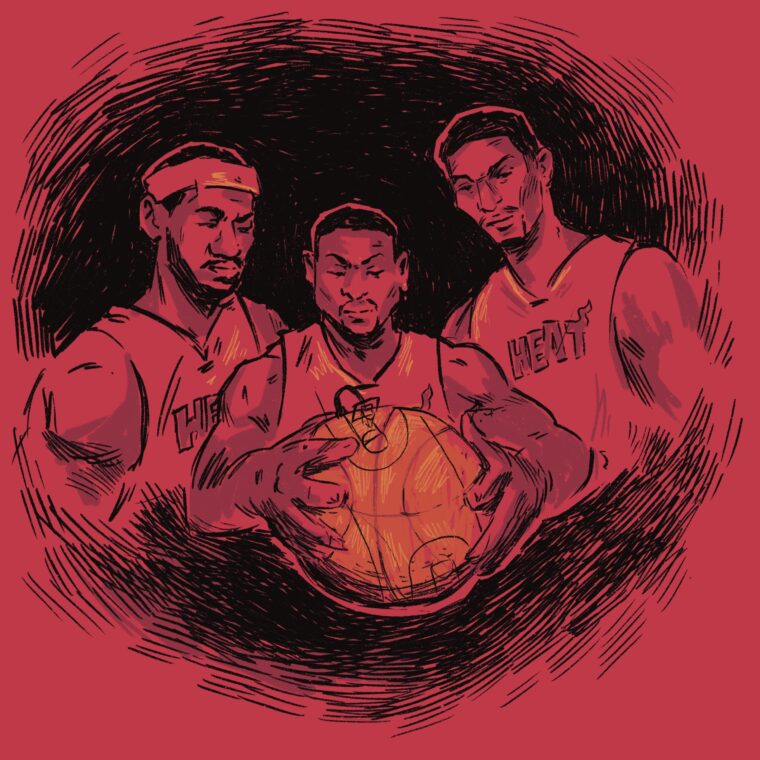
Illustration by Tuesday Hadden | Student Life
When Lebron James famously announced his decision to “take his talents to South Beach,” fans were livid. The NBA was surely doomed to be under the Miami Heat’s complete control for the foreseeable future, with James, Dwyane Wade, and Chris Bosh running the show, so why even watch? What ended up happening: the Heat were a great team but only won two championships in four years. More importantly, though, fans were able to witness some of the greatest playoff series in NBA history. We got to see Dirk Nowitzki and a bunch of 30-year-olds out-strategize the Heat, Lebron dominate back-to-back elimination games against the loaded Boston Celtics, and Ray Allen shock Spurs’ fans with a single “Bang!” The fact of the matter is, that the NBA is better when there are superteams–teams with at least three stars–to watch, support, and fear.
One of the biggest reasons why superteams are so great for the NBA is the quality of basketball. No matter the season, fans are going to see high-level basketball in the playoffs, but when the best talents are working alongside each other, it’s poetry in motion. There was nothing like witnessing Draymond Green make a defensive stop, passing it to Steph, who then swung it to KD running down the court, with KD finding Klay Thompson for an open three. Now imagine that, on the other side, you have Lebron, Kyrie Irving, and Kevin Love. Superteams stop the need to imagine; basketball purists can watch the game at its highest form.
Additionally, superteams create and amplify the most important factor in sports: storylines. Was there anything like seeing KD return to OKC after leaving longtime teammate Russell Westbrook? When there are tumultuous personal relationships on the court, people love watching, and that’s exactly what superteams bring. Or what about being present as the Cleveland Cavaliers and Golden State Warriors face off year after year, with past matchups and feuds rolling over and impacting the following series? Fans love continuing storylines, with the best players seeing each other in the playoffs on multiple occasions.
Superteams are far from a new occurrence in the league; there have always been teams that, on paper, look godly. There’s the 1980s Los Angeles Lakers and Celtics, the 1990s Chicago Bulls, and the late 2000s Celtics. However, in each of these years, it was considered to be a great time for basketball. The times when the league struggled, notably in the 1970s and mid 2000s, were when there was no dominant squad. Fans may complain that their team has no shot of beating a roster consisting of multiple household names, but they’ll be much more invested in these games.
The biggest criticism of superteams is a lack of competitive parity, as some claim that it makes the season result known before any games are played. Let’s take a look at some recent examples. Sure, you could single out the KD Warriors as a case of a team that was never going to lose, but what about the 2021-22 Brooklyn Nets, 2022-23 Phoenix Suns, and 2014-15 Cavs? All of these teams had three hall of famers playing near the top of their game, yet none of them won a ring, and there’s two main reasons why. First, the NBA is littered with injuries, and rarely are teams able to keep a complete squad through the end of the postseason. Second, the amount of top-level talent in the NBA is so large that no single team can be odds-on favorites to win.
When looking at Finals odds for the 2023-24 season, the Boston Celtics have the greatest implied percentage at 21.3%. Two organizations that recently joined the superteam discussion this offseason after sacrificing future picks, the Milwaukee Bucks with Damian Lillard and the Los Angeles Clippers with James Harden, are both given odds below 20%. The Phoenix Suns, starting KD, Devin Booker, and Bradley Beal, are below 15%. In the modern NBA, there are around 15 teams with at least two borderline all-stars, so no single team is at that much of an advantage.
While there’s always been superteams, only in recent years has there been a sentiment that they’re ruining the league. In my opinion, it’s because players are finally becoming agents of their own fate and rightfully having a say in where they play. If a playoff team quietly trades for another star, everything is fine, but the second that the star starts using his leverage and publicity to get to another team, it’s a problem. There’s a double standard, and while it’s not the fault of the teams, it’s definitely not the fault of the players.
Stay in Touch!
Get the latest and top news from StudentLife delivered to your inbox