Sports
Ray Rice case demonstrates issues in media, victim blaming and league response
Let’s start here with the Ray Rice case: do not blame Janay Rice under any circumstances. If you are blaming Janay Rice under any circumstances, then stop. Immediately. Domestic violence is a remarkably complex issue, and Janay choosing to marry Rice does not negate her victimhood.
The perpetrator here is Ray Rice. The aiders and abettors are the NFL and a legal system that let Rice off with a two-game suspension and no jail time or probation, respectively.
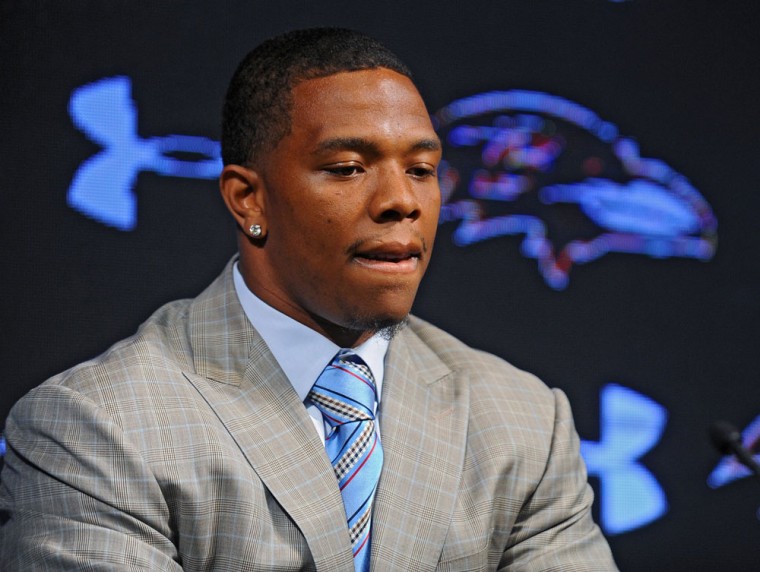 Kenneth K. Lam | Baltimore Sun | MCT
Ravens running back Ray Rice and his wife Janay made statements to the media on May 5, 2014, at the Under Armour Performance Center in Owings Mills, Md, regarding his assault charge for knocking her unconscious in a New Jersey casino. On Sept. 9, 2014, Rice was released from the Baltimore Ravens after a video showing the incident surfaced on TMZ.
Now that TMZ has forced the NFL into action by releasing a full tape of Rice’s assault in an Atlantic City casino’s elevator, however, it’s time for a contemplation of what this latest turn means. On the topic of TMZ, Amanda Hess of Slate has a strong piece about the outlet’s role as watchdog in the Rice case and other high-profile sports incidents.
Hess points out that TMZ released the audiotapes of disgraced former Los Angeles Clippers owner Donald Sterling’s racist rant and brought attention back to an accusation of sexual assault against Florida State’s Heisman Trophy winner Jameis Winston.
TMZ has pierced through what can be considered an intractable power structure in sports, bringing justice to those for whom it was long overdue—and as owners, league executives and fans turned a blind eye. Sterling, for instance, had years of racial and sexual harassment claims against him, but not until TMZ caught him on tape did his NBA franchise ownership crumble.
But Sterling’s downfall raised the question of why society only cared about a TMZ recording. Years earlier, the real estate magnate paid a record-setting settlement after a Justice Department lawsuit demonstrated his culpability in vicious housing discrimination.
Similarly, the NFL and Baltimore Ravens (Rice’s former team) needed a brutal video to mete out punishment of any substance. In fact, the Associated Press is reporting that the league indeed already saw the video, which shows that only after public release did Commissioner Roger Goodell and his cohorts approach the issue seriously. Meanwhile, Janay Rice endures the re-victimization of abuse being broadcast all over the Internet and national media.
Like the Sterling case, the Rice fiasco begs us to ask whose voices matter in sports and which ones are conveniently ignored. Limiting the scope of a scandal has been the NFL’s priority all along, and the belated reactionism of Rice’s release and an indefinite suspension does not change this dynamic.
The NFL did take a nice step by significantly bolstering its punishment for domestic violence to a six-game suspension for the first offense and lifetime ban for the second. But if the NFL cared more about protecting domestic violence victims than TMZ’s exposure, we would be talking about Greg Hardy of the Carolina Panthers and Ray McDonald of the San Francisco 49ers just as much as Rice.
Hardy played in week one despite testimony from a woman he allegedly assaulted that Hardy “pulled me from the tub by my hair, screaming at me that he was going to kill me, break my arms and other threats that I completely believe.”
The defendant goes on to state that Hardy choked her and threw her on a couch filled with loaded assault weapons. McDonald also played despite an incident that left his fiancee with “visible injuries” when police arrived.
Domestic violence is systemic in the NFL, systemic in professional sports and systemic in society. We should not need a video of one athlete to prove it when so many others have been implicated.
The Rice case makes me think of two particular athletes who have been involved in domestic violence incidents: ex-NBA player Ron Artest (now Metta World Peace), who was convicted in 2007 after an altercation with his wife, and Brandon Marshall of the Chicago Bears, who has been arrested twice on domestic violence charges, though convicted neither time.
Both deserved stronger punishment than they received, but bucking a culture of complacency on domestic violence (without TMZ video, that is), Artest and Marshall took it upon themselves to transform.
Marshall, who was diagnosed with borderline personality disorder, has since spoken eloquently about an ignorance of mental health issues and their intersection with anger and violence. During the Miami Dolphins’ bullying scandal last year, Marshall further unpacked the NFL’s culture of hyper-masculinity and its detrimental effects. Artest has spoken extensively about struggles with mental health and a history of alcoholism and violence in his family.
Of course, the burden of reform is always on the abuser regardless of the circumstances, and Artest and Marshall are no exception. Even so, it is the responsibility of their leagues to guide them and rectify cultural problems, thus protecting more potential victims.
Mental health may not have played any role in Rice’s violence, but socialization into a destructive expectation of masculinity certainly did.
Either way, Rice should not sniff a football field this season. It’s too early to even discuss when or if he should ever be allowed to suit up in the NFL again. But he can look to Marshall and Artest as examples of what he can do to change. Meanwhile, the NFL and its fans can stop relying on TMZ and start finding nuanced solutions involving discussions of mental health and dealing properly with anger.
Stay in Touch!
Get the latest and top news from StudentLife delivered to your inbox