News
Chief White House economist defends Trump administration policies
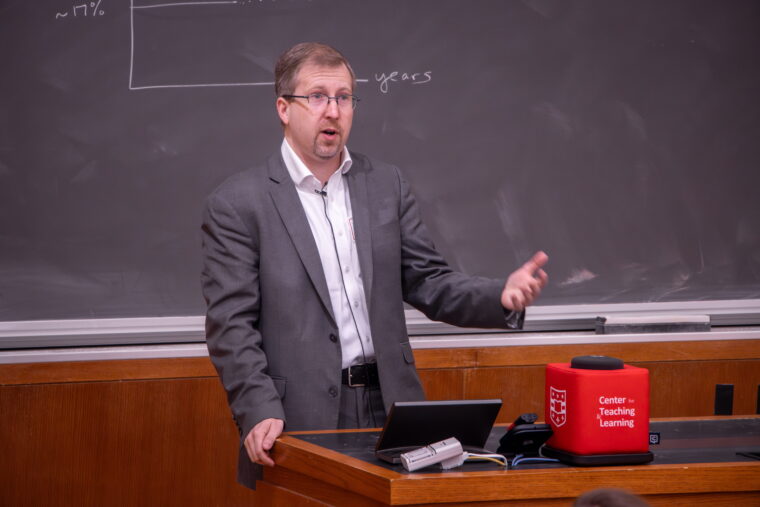
Aaron Hedlund, Chief Economist at the Council of Economic Advisers (CEA) at the White House, discussed economic policy. (Lakmé Bergeret | Contributing Photographer)
Aaron Hedlund, the Chief Economist at the Council of Economic Advisers (CEA) at the White House defended the actions that the Trump administration has taken with the economy, including tariffs, the One Big Beautiful Bill Act, and deregulation efforts, Feb. 20.
The event titled “The Economic Forecast from Inside the Trump White House” was hosted by the Weidenbaum Center on the Economy, Government, and Public Policy. Some students attending the event expressed criticism of Hedlund’s justifications of the Trump administration’s policies in interviews with Student Life following the event.
During a post-event discussion with attendees, Hedlund learned that the Supreme Court had just struck down many of President Trump’s tariffs. In an interview with Student Life, Hedlund emphasized the White House’s plans to reimplement the tariffs using alternative legal avenues.
“There was no heads up as to what the legal ruling was going to be, but there are a number of different legal authorities for tariffs,” Hedlund said. “The president is obviously committed to his trade agenda. It’s part of his overall economic agenda, and the White House will rule out its response, I’m sure, in very short order.”
As Hedlund suggested, new tariffs went into place later that day under a new executive order.
Before entering the White House, Hedlund was an associate economics professor at Purdue University where he is currently on leave. He is also a research fellow at the St. Louis Federal Reserve.
Hedlund was originally scheduled to give his talk on Oct. 24 but was forced to reschedule to this spring due to the government shutdown that occurred from Oct. 1 until Nov. 12. Hedlund commented on the economic damages that this shutdown incurred, and how it impacted the U.S. GDP data that was released earlier that morning.
“You had almost 4% growth in the second, third quarter, and then the headline number that came out today was that GDP grew at a 1.4% rate in the fourth quarter,” Hedlund said. “But if you read under the headline, you’ll actually note that growth would have been nearly 3% absolute shutdown. That’s the real consequence of these sorts of actions.”
During his talk, Hedlund discussed the One Big Beautiful Bill, Trump’s signature legislation passed last year, alongside the introduction of “Trump Accounts” — a check of $1,000 sent to new parents between 2025 and 2028.
This was presented as a new form of alternative asset investment — an opportunity for citizens to have to invest in their retirement through less conventional higher risk means, including private equity, real estate, and digital assets, which was legalized by Trump in an executive order. This type of investment was previously discouraged by the U.S. Department of Labor.
“Obviously, there has to be guardrails to make sure things are safe,” Hedlund said. “But the idea that there’s an entire asset class which has been very valuable to people that’s just completely off limits to an average person is not great, and that’s where that policy change is going to be very helpful.”
In the latter half of the panel, Hudlund took questions from the audience regarding the economic impact of tariffs, age demographics, and AI.
“You’re not gonna put AI back in a box,” Hedlund said. “It’s not going to go away. It’s happening. We want to make sure that businesses can adapt as quickly as possible, so that we can utilize the growth impact of that.”
During an interview with Student Life, Hedlund defended the Trump administration’s decision to cut several federally funded grants from universities around the country, including WashU. He argued that previous grants gave too much extra overhead money for administrative implementation of research.
“The administration is committed to a number of different things in higher education. One of those is ensuring that dollars go to their productive use,” Hedlund said. “The NIH and others have been very focused on kind of tackling excessive overhead. It’s widely known that many universities charge very high overhead for grants.”
First-year Alden St. John had mixed reactions to Hedlund’s explanations and responses to questions.
“I was kind of listening with a healthy dose of skepticism,” St. John said. “I think he kind of brushed aside the concerns about consumers eating the tariff costs, … so I think I’m not leaving feeling any more reassured about the economic prospects under this administration.”
Sophomore Ethan Skolnick did not see the logic behind Hedlund’s answers.
“I asked a question about business investment and tariffs, how the latter would seem to reduce the former,” Skolnick said. “I personally don’t think that the explanation that the threat of tariffs is going to work, because if tariffs did go into effect, that inherently lowers investment. I didn’t find that the most convincing.”
St. John concluded with an appreciation for being able to hear about the inner workings of the White House economic policy from an academic.
“It’s reassuring to know that there are some sort of experts that are still there to advise policy,” St. John said. “They are still delving into models and making calculations, and there’s some information that is going into these decisions.”
Stay in Touch!
Get the latest and top news from StudentLife delivered to your inbox