News
Inside the simmering labor dispute at Kaldi’s Coffee

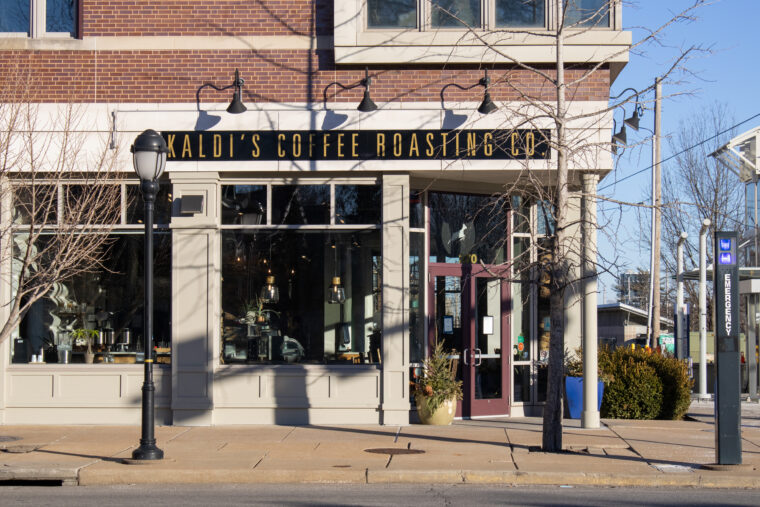
Students enter the Kaldi’s location on Skinker Boulevard, across the street from WashU’s campus. (Rachel Benitez-Borrego | Staff Photographer)
In late August, a group of Kaldi’s employees, along with professional labor organizers, staged a protest inside the Skinker location of Kaldi’s Coffee, a popular study spot for WashU students. This development was the culmination of months of disputes over a lack of air conditioning, drainage issues in the kitchen, and an employee who union organizers allege was fired for raising these issues with management.
While the air conditioner is now fixed, the labor dispute is ongoing. The kitchen in this Kaldi’s location remains closed, as it has been for almost two weeks. Simultaneously, labor organizers and Kaldi’s employees are attempting to unionize multiple Kaldi’s locations across St. Louis.
The protest included organizers from the St. Louis chapter of the Party for Socialism and Liberation (PSL) and organizers from the Missouri Workers Center (MWC). The MWC is the main force behind the unionization effort but declined to comment on this article.
Addie Gray, an organizer for PSL who participated in the protest, said the issue began when the air conditioner in the Skinker location went out.
“From my understanding, people have been passing out in the kitchen due to the heat, because obviously it’s been an extremely hot summer, and in the kitchen it’s even hotter,” Gray said. “There have been times when there has been sewage water on the floor with no air conditioning, and management [didn’t] do anything to fix either of these problems.”
Kaldi’s denied that any employees passed out over the summer. They did not comment on the allegations that there was sewage water on the floor, but said the issues in the kitchen stemmed from a grease back-up.
In a statement to Student Life, Cynthia Daniels, the People Director at Kaldi’s Coffee, said Kaldi’s closed the kitchen at the Skinker location to allow for repairs.
“We recently had some grease-related backup issues in the kitchen, so we closed our kitchen until it can be fully repaired,” Daniels wrote.
When exactly the air conditioning first stopped working is disputed. Gray claims it was in April. A current Kaldi’s employee, who asked to remain anonymous out of fear of professional repercussions and will be referred to as Employee X, seconded that claim.
However, Kaldi’s claims it was damaged in the May tornado that swept through St. Louis.
“Our records do not reflect any AC issues reported at the Skinker location in April,” Daniels wrote to Student Life in an email. “The May tornado caused a multiday power outage in the building and also caused damage to the AC unit. In July and August, building-level electrical issues again affected AC service; each time, we promptly engaged a licensed HVAC vendor to restore service as soon as possible.”
Kaldi’s also said that by the time of the Aug. 22 protest, the AC had already been repaired.
By contrast, Employee X suggested that the repair of the AC was due to the protest.
“[We] presented a petition signed by 20 union workers, and within a week the air conditioning was fixed. After months of ‘We’re looking into it,’ months of stalling, months of, ‘Well, it’s kind of half working,’ it was fixed,” Employee X said.
While WashU owns the building the Kaldi’s on Skinker is located in, WashU Vice Chancellor for Marketing and Communications Julie Flory said she was not aware of any involvement from the University.
Another major issue that led to the protest was Kaldi’s firing of an employee, which, according to Gray, occurred after the worker brought up the air conditioning and drainage issues to Kaldi’s management.
“[The management] basically said nothing, and a few days later, this worker was fired,” Gray said. “It’s pretty obvious the reason was because they were advocating for their basic human rights.”
The employee who was fired declined to comment on the record. On Aug. 29, a lawsuit brought by the law firm Schuchat, Cook & Werner was filed with the National Labor Relations Board against the coffee chain, alleging unfair labor practices, which could include the wrongful discipline or termination of an employee.
Daniels said that out of a respect for privacy, Kaldi’s could not comment on why the worker was let go. However, she expressed willingness to listen to employees.
“Kaldi’s Coffee is committed to openness and respect, and we support open dialogue about wages, scheduling, and working conditions to strengthen our workplace and our team,” Daniels wrote to Student Life.
She added that the chain adheres to health and safety standards.
“Kaldi’s complies with applicable health and safety requirements, cooperates with the responsible authorities, and remains committed to the well-being of our team, our guests, and the community,” Daniels wrote.
All of the issues above eventually led to the protest inside the Kaldi’s on Skinker on Aug. 22.
“[We] occupied the space … when management said ‘There’s nothing we can do at the moment,’ [we] basically said we’re going to stay here until someone who can do something comes to talk to us,” Gray said.
Gray said the August protest eventually ended when the workers on shift staged an impromptu walkout, causing the rest of the employees and union organizers to end their “occupation” of the Skinker location.
However, the labor dispute is not over, and Employee X expressed hope about what future organizing efforts at Kaldi’s would bring.
“I’m a proud worker, and I feel disrespected,” they said. “I’m so excited to be able to take more control over my life through the union.”
Editor’s Note: This article was modified at 11:20 a.m. on Sept. 19 to include that Kaldi’s denies that any employees passed out over the summer, that Kaldi’s claims the air conditioning in the Skinker location was repaired prior to the Aug. 22 protest, and that Kaldi’s says the drainage issues in the kitchen were related to a grease-back up, not a sewage leak. It was updated again at 3:20 on Sept. 20 to clarify Kaldi’s response about the nature of the drainage issues in the kitchen.
Stay in Touch!
Get the latest and top news from StudentLife delivered to your inbox