News
University forms Naming Review Board
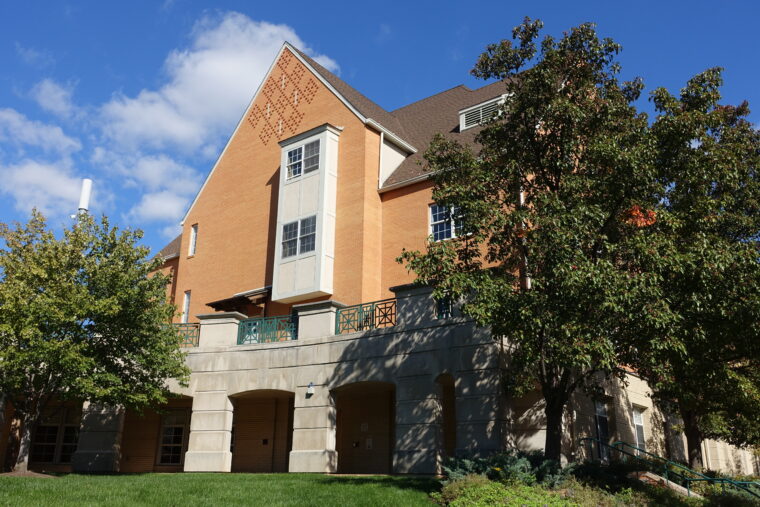
Wayman Crow Residential College was named for a co-founder of the University who was recently revealed to have been a slave owner. (Jialing Sun | Student Life)
The Board was created after the University’s Board of Trustees approved it in December as a product of the Committee to Examine Remembrance and Commemoration (CRC), an initiative implemented in January 2023 by the chancellor’s office.
Recently, the WashU community has been dealing with controversy around the names of certain buildings and university features, like the Wayman Crow Residential College located on the South 40. Crow was one of the co-founders of Washington University and a close friend of WashU founder William Greenleaf Eliot, and was recently revealed to be a slave owner. His lobbying efforts and monetary contributions persuaded the Missouri Legislature to establish Washington University in 1857.
Dr. Peter Kastor, the Associate Vice Dean of Research in Arts & Sciences and Samuel K. Eddy Professor of History, was appointed by Chancellor Andrew Martin to lead the board.
“The primary purpose of the Naming Review Board is to provide a process for evaluating situations where somebody questions how or what a campus feature is named,” Kastor said.
Kastor is optimistic about the role the board will play in helping people understand WashU’s history.
“Understanding the past means fully exploring the past and often grappling with really difficult elements of it,” Kastor said. “Anything that enables us to do that is good.”
The Naming Review Board does not preemptively evaluate the names of campus features. Rather, members of the WashU community who want a campus feature to be considered for re-commemoration or contextualization can submit a report now on the University’s website through an online form.
To submit a report, community members must identify why the name of a university feature violates WashU’s core mission, include supporting evidence, and identify the name and location of the feature in question.
The board’s membership will include members of WashU faculty, administration, staff, and student body. Once the NRB receives a report, its members will evaluate it using three metrics: whether a “significant aspect of the legacy of the named individual or entity is directly associated with slavery, genocide, or discrimination,” whether the individual or entity caused will likely cause harm to the community, or whether the individual or entity is directly tied to “criminal activity or other destructive behavior with broad societal impact,” according to the NRB website.
If the NRB decides that the report clearly reveals injustice on the part of the individual or entity for which the university feature is named, the NRB will submit a formal recommendation to the chancellor, and the chancellor will submit the recommendation to the Washington University Board of Trustees.
The Naming Review Board is a product of the Committee to Examine Remembrance and Commemoration (CRC), an initiative implemented in January 2023 by the Chancellor’s office. Rebecca Brown, Vice Chancellor for Strategic Initiatives and University Governance, chaired the CRC.
“The [CRC] started meeting in March [2023]. It met monthly. There were a few subcommittees, and then it provided its recommendations to the board at the end of November [2023],” Brown said. “There was a lot of outreach involved during that time.”
WashU joins several colleges and universities across the country, including Johns Hopkins University, The Ohio State University, and the University of California, Berkeley in creating boards and committees to evaluate renaming buildings and other features initially named after individuals or groups who supported or participated in unjust actions not in line with the institution’s values. The CRC looked to those other institutions when developing the NRB.
“There was a lot of benchmarking that was done by the committee throughout the process,” Brown said. “There are many institutions that have committees or that have set up processes either in response to something or proactively, and of course, ours was done proactively.”
Kastor emphasized the flexible structure the NRB adopted, making it clear that representation is the priority.
“A request could concern any part of the University, and there is space within this to make certain that the part of the University that’s affected is part of this process,” said Kastor. “That was part of what made this a useful exercise for all of us — developing a structure that would be sufficiently flexible to address the wide range of situations that can emerge.”
Other committee members and divisional designees include Vice Dean of Faculty Development and Diversity, Adia Harvey Wingfield, Director of Housing Operations, Will Andrews, and University Trustee Alicia McDonnell. A full list of committee members can be found on the CRC website.
WashU students can apply for a two-year appointment as an at-large member of the NRB on the CRC’s website. The deadline for applications is Friday, Feb 16.
Stay in Touch!
Get the latest and top news from StudentLife delivered to your inbox