News
WUPD policing practices deemed ‘a national model’ for other agencies
A professional firm specializing in campus safety called Washington University Police Department’s Fair and Impartial Policing (FIP) policy a national model in recently released findings following an independent review last August.
The firm, however, made a number of recommendations for WUPD to improve in areas including its transparency, formal assessment process and bias reporting and supporting services.
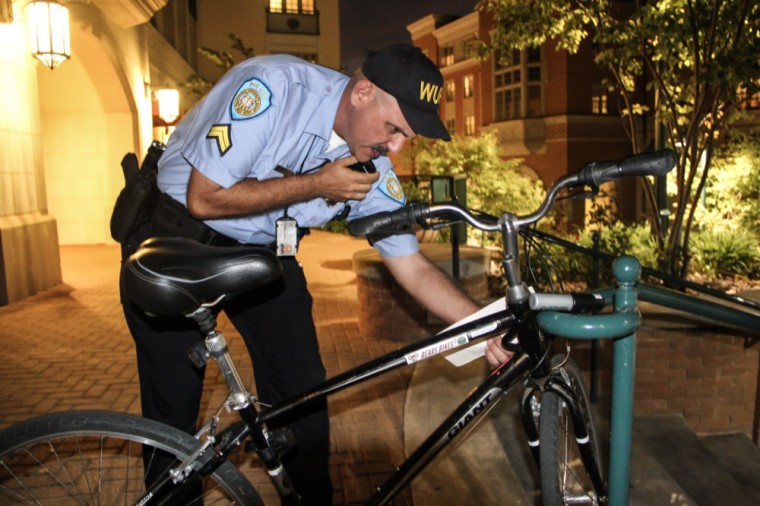
Officer Dave Goodwin marks an illegally parked bike on a railing for removal in 2014. WUPD police and security officers conduct campus safety checks around the clock.
The outside review recommends that the University police should collect, maintain and analyze demographic data, analyzed separately by school and non-school contacts, on all detentions (stops, frisks, searches, summons and arrests), as well as citizen concerns. Failure to include citizen concerns leaves out important information needed to address underlying issues existing between the department and the community, according to the report.
Washington University retained Margolis Healy & Associates LLC (MHA), a firm specializing in campus safety, security and regulatory compliance, to conduct the review while WUPD was under the leadership of former police chief Don Strom.
MHA identified several areas of improvement for WUPD, recommending the elimination of the specific practice of the Neighborhood Safety Patrol (NSP) program that involves members slowing their vehicles to follow students to ensure they arrive safely to their destination. WUPD discontinued this practice prior to the final report being issued, according to a University press release.
Additional areas of improvement include increasing transparency within the University community by posting daily traffic stops and field interview data on the WUPD website and establishing benchmarks to improve analyses and develop evidence-based, fair and impartial policing policies.
The University has addressed these recommendations in an independent press release and offered responses to all of the issues addressed in the review. According to the press release, WUPD command staff review all entries regarding stops on a daily basis. WUPD is also currently preparing a draft sample of reports detailing the traffic stops and field interviews that could be posted to the WUPD website on a monthly or quarterly basis due to the infrequent number of stops.
The firm’s report also includes a strong recommendation for the University to conduct an in-depth review of the Bias Report and Support System (BRSS), stating that the current system places a disproportionate impact and unfair burden on the Center for Diversity and Inclusion. The Center, among other things, supports and advocates for students from traditionally underrepresented or marginalized populations. The Center’s direct management of these types of incidents could send the unintended message that bias incidents are only a “minority problem,” according to the report.
Vice chancellor for student affairs Lori White has convened a working group to recommend improvements to the current system, according to the report.
Included in the report were recommendations for WUPD to consider establishing more formal assessments in the long-term to determine the full extent by which the FIP and Crisis Intervention Training (CIT) modifies officers’ behavior.
Sophomore Kiara Sample, a member of St. Louis Students in Solidarity, an organization composed of students from several area universities aimed at taking a stand against racial profiling and police brutality, is unsure about the University’s response to the recommendation.
“I feel like the qualitative evaluation would be the most important, because those are the main things that are supposed to assess whether the Fair and Impartial Policing policy has truly changed WUPD’s behavior. And it doesn’t seem like that will be implemented immediately,” Sample said.
In the University’s press release, Henry S. Webber, executive vice chancellor for administration, said that while the University agrees that qualitative evaluation data and formal assessments would be helpful information, it would take research and additional resources to design platforms to accomplish these goals. Those recommendations will be considered for implementation at a later date.
Jill Friedman, vice chancellor for public affairs, applauded WUPD’s work and commitment to progress.
“We feel that our students, staff, faculty and the entire Wash. U. community is under great care from a police perspective but that we also have WUPD officers that really do care; that is something we’re just extremely proud of,” Friedman said. “They make an exceptional difference not only on our campus, but in the St. Louis region, and have really earned the deep respect of their fellow officers in other municipalities and of course everyone within our own community. And it’s well earned. They do a great job.”
Stay in Touch!
Get the latest and top news from StudentLife delivered to your inbox