News
Community Service Office, Gephardt Institute merge, create new freshman volunteer program
Meet St. Louis, a new freshman community engagement program sponsored by the newly created Gephardt Institute for Civic and Community Engagement, will take place over the upcoming weekends and replace the tradition of Service First.
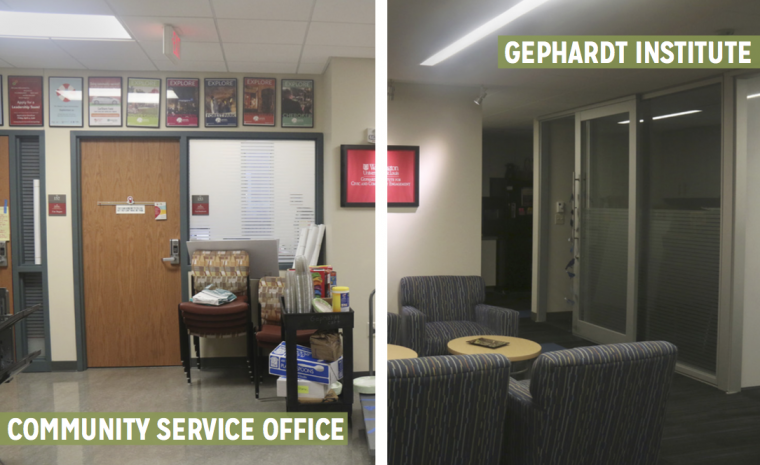 Jonathan Yue | Student Life
 The Gephardt Institute for Civic and Community Engagement prepares for the upcoming year. This
summer marked a merge between the Community Service Office and the Gephardt Institute for Public Service, who had previously been focusing on similar goals.
Meet St. Louis will consist of 34 “half-day” programs taking place over three dates, looking at a wide variety of issues that students can choose based upon their interests. Organizers hope that changes both to the program and to Gephardt will make service opportunities more accessible to students.
The current Gephardt Institute results from a merger between the Community Service Office and the Gephardt Institute for Public Service earlier this year. Meet St. Louis is aimed to address the limitations and successes of this former program.
Director of the Gephardt Institute Stephanie Kurtzman noted that the program’s release coinciding with the merge is purely coincidental, but that it makes perfect sense with the organization’s updated mission.
“It really is so perfectly aligned with the values of the institute and what I love most about it. That was a weakness for Service First in that it is both teaching and doing,” Kurtzman said. “Sometimes it’s important to learn before we do, and sometimes it’s important to listen in order to learn, and I think the students are really responding to that.”
Junior Lucy Chin, the Meet St. Louis coordinator, noted that her experience with Service First helped her to construct the program.
“When I did Service First I had a really good time with my floor and I felt like I was being helpful and preparing for the school year, but I definitely lacked context,” Chin said.
Chin noted that an important aspect of the new program that she felt would be a large improvement over Service First would be the discussion component and “what’s next” packets. Students will be sent home with a packet of information about how to volunteer again or with related organizations after taking part in reflective discussion.
“Each of [the half-days], which is one of my favorite aspects of the program, is complemented by an hour of reflective discussion,” Chin said. “So within the half-day there will be a really intentional conversation about what the service meant, what the tour meant, how you as a student are implicated in the issues that are taking place in and around the city, and what you can do to step outside of your role as a Wash. U. student and be part of the community in St. Louis.”
The half-day programs will be making use of public transportation as both a budgetary and educational component. While it should save the program money, Chin and Kurtzman noted that the use of public transportation will also serve to more deeply integrate students into the city.
“I’m not a fan of huge school buses going into communities when we can avoid it—but really it was also part of the experience, not just of learning public transit, which is important, but actually seeing the community and viewing [transportation] not as a disruption or a distraction to what we’re there to do, but making it part of the experience of the entire half-day,” Kurtzman said.
Meet St. Louis will be much smaller than Service First, with 634 slots for freshmen and a few residential advisers, but may expand over time.
“We really wanted to focus on the quality of the experience and doing it right rather than just ushering in more and more experiences or asking the half-day coordinators to increase their slots beyond what they thought was appropriate,” Kurtzman said.
“Part of our goal was not to do this as cookie cutter as Service First was…to really make this customized around the needs and the vision of each half day,” she continued.
Although this means there won’t be a spot for everyone interested, Kurtzman said they have hopes for the program to grow to a size comparable to what Service First was.
Other changes the Gephardt Institute will be seeing in the next year include faculty grants to support development and expansion of courses with community engagement components, which are designed to remove barriers to service, as well as a new office hours model.
“We’re going to move those [drop-in hours] to Cafe Bergson in the [Danforth University Center] and invite people to have coffee with us, and we’ll pay for the coffee, the pastry, but let it be more of a conversation,” Kurtzman said. “So it might be a transactional visit, but it might be just a chat with no real directive about what the person is trying to accomplish other than to grapple with these complicated issues.”
The institute is also using a new slogan to promote its updated mission: “Involvevolve.”
“What’s important for us is to think about engagement across the spectrum…so for us it’s about involvement…not just of the Washington University community but the external community. And from that then the community can evolve,” Amanda McBride, executive director of the Gephardt Institute, said.
Stay in Touch!
Get the latest and top news from StudentLife delivered to your inbox