News
Design competition brings 10 distinctive sukkahs to campus
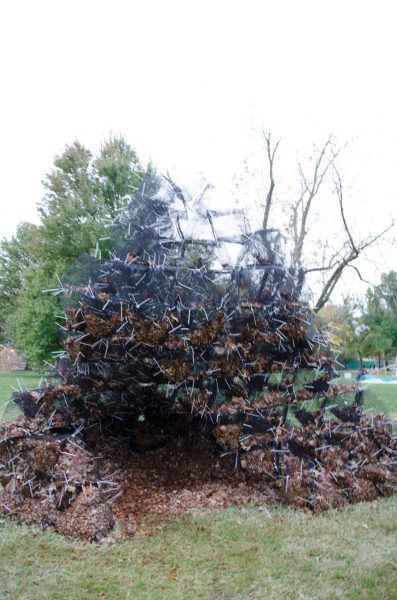
St. Louis Hillel’s Sukkah City 2014 has built a home on the lawn in front of the Women’s Building.
Sukkah City’s 10 sukkahs were constructed as part of a competition marking the Jewish holiday of Sukkot, during which observers eat meals in outdoor shelters. The weeklong holiday began on Wednesday evening at sundown and concludes Oct. 15.
 Brian Benton | Student Life
 The “Super Sukkah” sculpture lights up the lawn outside Olin Library. The Sukkah in the City event is sponsored by St. Louis Hillel and the Sam Fox School of Design & Visual Arts.
The first Sukkah City STL occurred in 2011 as a collaboration between the Sam Fox School of Design & Visual Arts and St. Louis Hillel. After a three-year hiatus, the competition has returned to Washington University’s campus, attracting designs from students and architects throughout the United States. The 10 sukkahs currently on display were selected from 33 entries, and each winning team was awarded $1,000.
Jacqueline Ulin Levey, president and CEO of St. Louis Hillel, is one of the co-chairs of this year’s event. According to Levey, Sukkah City STL 2014 helps to recall the past and symbolize the harvest period embodied by Sukkot. She also emphasized that the event reimagines the ancient sukkah and nomadic architecture for the 21st century.
In particular, she is excited about this year’s theme, “Between Absence and Presence,” which she believes provides an interesting lens to examine how people interact with the world.
“So much of our relationships today happen through social media,” Levey said. “So much of what’s happening in the world we see through Facebook or pull up through our iPhones and Samsung Galaxies, and so what does it really mean to be present? Oftentimes are we absent even though we are trying to be present? How can an architect reflect that through their structure?”
 Brian Benton | Student Life
 The “Surface to Sukkah” sculpture is lit by moonlight. The Sukkah City exhibit will be open until Oct. 12.
Levey said she hopes that all students, regardless of faith, use these sukkahs to reflect and think about their own lives. She encouraged them to read the descriptions of each structure and consider their meanings.
Levey was also proud of the collaboration between St. Louis Hillel and the Sam Fox School, saying she believed the two institutions worked well to combine Jewish tradition, architecture and the year’s theme. Noting that the Hillel building and the Sam Fox buildings are just across the street from each other, she said she was keen on future collaboration.
The sukkahs come from designers across the nation. Levey said that Sukkah City STL is unique because it focuses on the campus environment and reaches out to emerging designers and design students.
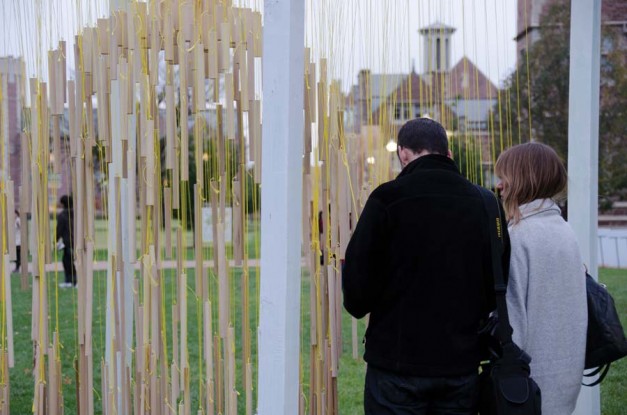
Ken McCown, Downtown Design Center director at the University of Nevada, Las Vegas, spent Monday helping assemble his work. McCown’s work, created with three co-designers, is named “Yachad,” the Hebrew word for unity. The installation consists of several pieces of wood veneer woven together. Going by traditional guidelines, the top of the sukkah is open, allowing light to channel into the shaded meeting place below.
“It’s a really wonderful opportunity to use our design skills to help people realize what they want to realize in life,” McCown said. “We’re just really excited to be here and excited to be a part of this whole event.”

TAO + Lee Associates’ “A Tensile Community” structure sits outside Olin Library. The sukkah is one of 10 selected to be displayed on campus.
Although some students were initially confused about the purpose of the structures, several said they appreciate the sukkahs’ presence.
Freshman Adrian Levitt believed the sukkahs add aesthetic value to campus.
“I didn’t really know what they were when they were being put up, but now that I see the signs, they’re pretty cool,” Levitt said. “I think they’re fun to look at, and it’s nice to see the creativity that goes on here.”

Marc Manack, Frank Jacobus and helpers build their “Super Sukkah” sculpture Sunday night. There were 33 sculpture designs entered in the competition to be built on campus.
Junior Emily Brown thought that the works provide cultural and academic significance on campus.
“I think it’s great, the collaboration between Hillel and Sam Fox and how they’re able to incorporate the meaning of such an important religion and architectural expression,” said Brown. “Since it’s put in such a prime location, it’s nice because everyone is going to look at them and learn more about Sam Fox and also learn more about the Jewish religion [and] Sukkot.”
However, freshman Leigh Berman was not too affected by the displays.
“I think that everyone kind of thinks they’re Halloween decorations,” Berman said. “I feel kind of guilty for not knowing what they were because I’m Jewish.”
 Brian Benton | Student Life
 The “Super Sukkah” sculpture glows in front of Olin Library. The sculpture was designed by Marc Manack and Frank Jacobus from Fayetteville, Ark.
Stay in Touch!
Get the latest and top news from StudentLife delivered to your inbox