News
WashU students react to new data on the postgrad earnings of different majors
On Oct. 7, The New York Times published a report featuring an interactive database highlighting 32,578 undergraduate programs at 24,526 universities across the U.S. The article draws on an analysis by the HEA Group, a higher education research firm, of the Department of Education’s earnings data for students who received federal financial aid and graduated in 2017-19. 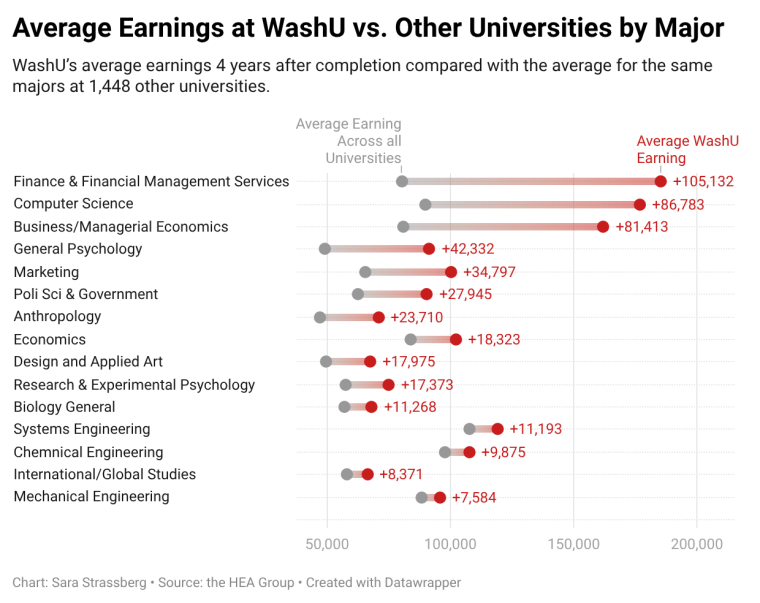
It allows readers to compare the average salary for graduates of different majors at their university, or of the same major across different universities. Only 17 majors were tracked for WashU specifically, and that number dramatically varied by university.
Across all 17 majors tracked at WashU, graduates earned more on average four years after completing their degrees than graduates of the same majors across other universities in the dataset. The largest gap was in finance and financial management services, where WashU graduates earned $105,132 more on average, followed by computer science at $86,783, and business/managerial economics at $81,413.
WashU students are part of the growing number of university students to consider expected salaries when deciding their future career. When shown the average earnings of a WashU psychology major, $91,787, first-year Sophia Naronov acknowledged that in addition to her passion for medicine, part of her reasoning to attend medical school was due to the high compensation.
With WashU’s reputation of preparing students well for medical school, Naranov felt that her expected salary would justify WashU’s high tuition.
“I don’t know if I could confidently say that paying $100,000 a year is worth it anywhere, but part of the reason I chose to go here was because I knew it would set me up for success, especially being premed,” Naranov said. “I think a lot of the aspects of going to the school are worth it. But I don’t know if I can say that the high tuition is necessarily reflected [for others].”
The most recent consumer price index report from the Bureau of Labor Statistics published in October showed that prices of items in the U.S. have increased 3.7% since last September. With the increased cost of living, many are wondering whether or not a college degree is worth the money. The cost of living going up, combined with an increasing WashU tuition, brings up new questions about the benefits versus drawbacks of a WashU education.
Parents and students are also weighing potential earnings when deciding which majors are worth the cost of a WashU education. First-year Claire Schwartz said she has been reconsidering her choice of major with her parents because of the relatively low salaries associated with Earth science degrees.
At the same time, she said WashU’s connections with high-profile employers, such as NASA, could make the cost worthwhile for students who secure opportunities through those relationships. However, she noted that not every student benefits equally from those connections. 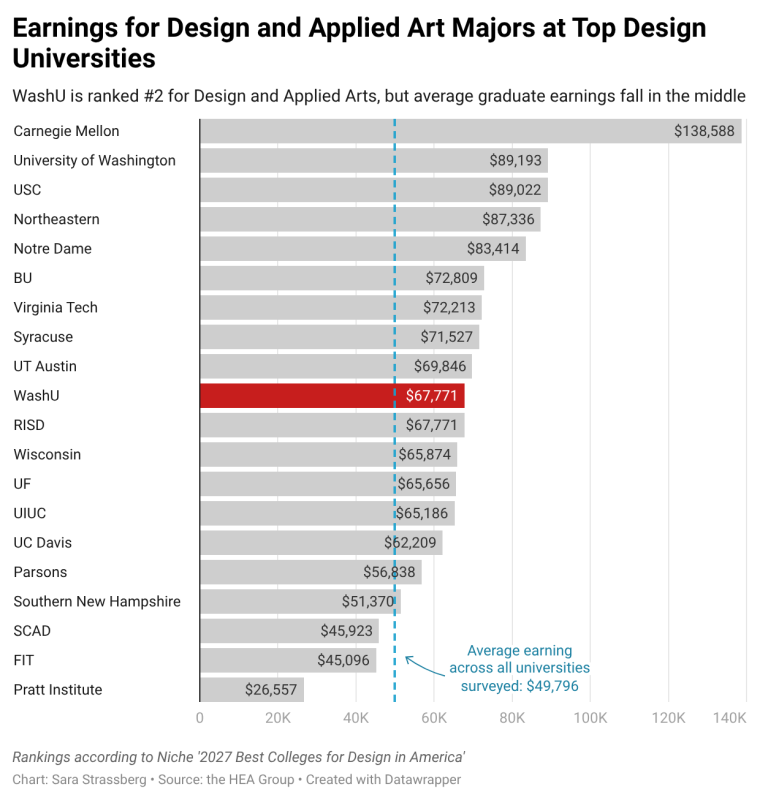
Junior Naomi Turk has similar concerns about her BFA communication design major. Despite Niche ranking WashU as No. 2 for Design Schools, the average salary of WashU design and applied art major graduates is less than many other lower ranked schools. In Turk’s experience, WashU’s design program doesn’t receive much recognition, and this has disadvantaged her in her job search.
“All of the opportunities that I’ve gotten have been through cold emailing or just networking, which is the name of the game now, and that’s fine,” Turk said. “It kind of contradicts the point of going to a school with a really good program and a school that’s well known, if the program isn’t well known.”
WashU’s design program has a wide coverage, with students in the communication design program specializing in fields such as graphic design, interaction design, and illustration, and others in the fashion design program focusing on both fashion and textiles.
“Compensation can vary widely across these fields, which also have greater and lesser levels of volatility,” said D.B. Dowd, chair of undergraduate design in the Sam Fox School’s College of Art.
The HEA Group’s analysis focuses solely on earnings for bachelor degrees, which documents the average earnings for various majors by university four years after graduation, and each program’s risk status for federal aid eligibility. Dowd felt this time frame doesn’t capture the whole picture for those in the design field.
“Our alumni who end up in animation, for example, most often work in story departments, which take a while to get started in. In illustration, comics, and animation, particularly, a four-year time horizon is an early measurement,” Dowd said.
With these new considerations concerning the benefits of specific majors, there is an advantage to choosing a major that provides many options for post-graduation careers.
First-year Isabella Pikner emphasized the importance of majoring in a subject that is flexible with the career opportunities it affords students.
“My end goal was always biostats, but by the end of my four years I [may] decide that I want to do a different field in statistics,” Pikner said. “It’s a bit of a safer foundation to pivot from [biostatistics] to go into any sort of statistical modeling that lots of businesses need. So I do have that sort of safety net. … My main goal is stability.”
Stay in Touch!
Get the latest and top news from StudentLife delivered to your inbox