News | Uncategorized
‘A big puzzle’: music students deal with loss of the South 40 music building
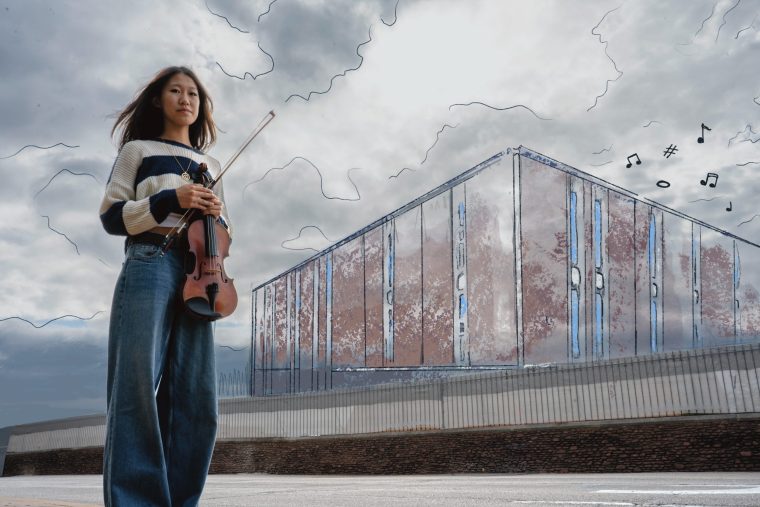
Music student Zhaoyi Zhong in front of the former Gaylord Music Library (Mat Motz | Photo Editor; Tillie Szwartz | Design Editor)
Last spring, WashU knocked down the music building on the South 40 where many WashU music students had their lessons and practiced their instruments.
With the music department now spread across campus students and professors are facing various logistical challenges, including getting to lessons and finding sufficient practice rooms. For many students, Director of Programming and Applied Music Jennifer Gartely said scheduling music becomes difficult.
“[It is] a big puzzle that you put together at the beginning of the semester,” Gartely said.
With the change, more students have to take shuttles to the off-campus 560 Music Center, which is the department’s other major hub and was also used before the move. The problem is especially noticeable when large ensembles meet, as some have anywhere from 70-100 students. Gartley explained that when all those students are getting on the shuttle at the same time, some have to wait for a second shuttle. Still, transportation has improved significantly since 2007, when the 560 Music Center opened right next to the Delmar Loop.
“The situation we are in now is heads and tails above where we used to be,” Gartely said,
For first-year violinist and chamber ensemble member Zhaoyi Zhong, the trip can add around 40 minutes to her schedule.
“The music center shift has forced me to leave an hour early to catch a hopefully empty shuttle,” Zhong said. “However, this affects instrumentalists with larger instruments much more. Cellos, tubas and other large instruments are inconvenient to walk with for long periods of time or carry onto a shuttle.”
According to Gartley, the WashU Department of Music is home to around 700 students who are either taking lessons or performing in an ensemble. These students comprise almost 10% of the WashU full-time undergraduate population. It’s reported by the current department chair, Alexander Stefaniak, that the music department hasn’t seen any changes in enrollment.
The situation began about four years ago when WashU administration told former department chair, Patrick Burke, the music buildings on the South 40 would be bulldozed. Stefaniak explains that the administration simply told them the reason for taking down the music buildings.
“We need to build a new dorm … we don’t have a plan for where to put you yet,” Stafaniak said.
The following years were spent in a constant back and forth between administration and the music department, trying to figure out where music students and faculty could go. According to Stefaniak, with the assistance of the Music Departments Relocation Committee and testimony from students, the music department was able to secure two separate locations on campus: Seigle Hall and Lopata House.
Another concern is practice rooms. Before the relocation, there were fifteen practice rooms open to students. Now, there are seven in Lopata House, which are temporarily prioritized for students enrolled in music classes, lessons or ensembles. The department plans to return to 15 practice rooms during the 2026-27 academic year, adding spaces in Eads Hall and the 560. While spread out practice rooms are not ideal, Stefaniak highlighted that the new rooms are an upgrade in quality, with better construction and soundproofing.
And while at the time students felt the major loss of the Gaylord Music Library, which served as both a resource and gathering space, its materials are still accessible in Olin Library and are now easily reached by students and faculty outside the Music Department.
“It is nice that our collections are in the main, centrally located campus library,” Stenfaniak said.
What’s harder to replace is the community space that Gaylord provided. Stefaniak described it as “a really inviting place to work and study and congregate.” New gathering spaces in Lopata and Siegle may begin to fill that role, but the department is still adjusting.
Even with the distance, student involvement has not dwindled. Zhong said that the relocation “hasn’t really affected the community.”
For Gartley, protecting the student experience has been a central concern throughout the transition.
“From the department’s standpoint, we have really centered the student experience this entire process,” Gartley said.
Stefaniak said the music department is designed to be accessible to all students. He described it as a place for both experienced musicians and students with no prior experience who just want to explore.
“This isn’t just a department for students who are coming to WashU and have taken 10 years of lessons, or taken AP music theory, or they already have a composition portfolio,” he said.
The music department may no longer have one physical home, but according to Stefaniak, its goal remains the same: making music accessible to the WashU community.
“Music is integral to how our undergraduates approach the humanities and creative practice,” he said.
Stay in Touch!
Get the latest and top news from StudentLife delivered to your inbox