Scene
Make me a match: Jewish matchmaker proves matchmaking is still in style
(Bri Nitsberg | Student Life)
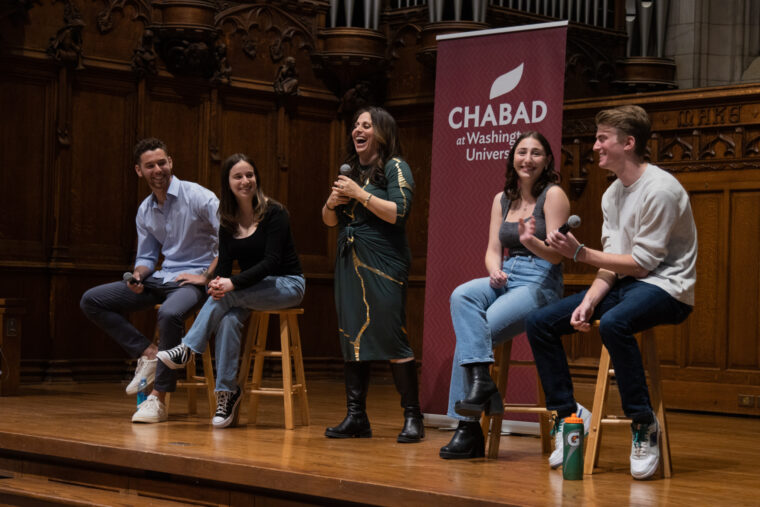
Matchmaker Aleeza Ben Shalom isn’t messing around when it comes to finding love, and college, she believes, is the perfect time to find a partner. The star of the popular Netflix reality show “Jewish Matchmaking,” Ben Shalom, has helped bring together more than 200 couples and offered her advice to WashU students during her talk in Graham Chapel on April 9.
“Don’t leave university without your person. And you [may need to] go back and get higher education and get another degree. More importantly than leaving with your degree — everybody’s gonna graduate and you’re gonna get a degree — find your person. That should be your mission,” Ben Shalom said.
Prior to her talk, Student Life met with Ben Shalom. Despite three intermissions to deal with some wasp attacks, she was just as enthusiastic and passionate as she is on her Netflix show.
During her talk, Ben Shalom revealed that she did not plan to be a matchmaker after graduating from the University of Pittsburgh with a degree in Interdisciplinary Studies.
“You know what that means? Nothing! I’m qualified to do nothing!” she said.
Post-graduation, she worked odd jobs until she started as a volunteer matchmaker. Not long after, her career snowballed dramatically.
“Shidduch” is the Hebrew word for matchmaking, a Jewish tradition stemming from ancient history and now existing in different forms in multiple Jewish communities. It’s popular in Orthodox Judaism, which is the more observant Jewish denomination. Traditional Jewish matchmaking entails matching two Jewish people together to eventually marry. Although the concept has changed to become more modern, some Jewish singles still look to matchmakers for dating advice. Ben Shalom has made a name for herself by doing just that.
“From volunteer matchmaking, I started coaching, and then I started training coaches and training matchmakers. And then I started this company because I was so passionate about matchmaking that there was nothing else I wanted to do in the world,” Ben Shalom said.
Ben Shalom emphasized how matchmaking, and the portrayal of the practice on the show, can bring positivity to the Jewish community in a time of particular tension and division. Although some may disagree about whether college is more about finding a partner than getting your degree, Jewish matchmaking brings people together, not only as romantic partners but as a community. On the show, Ben Shalom is able to help spread that message.
Ben Shalom’s involvement with Jewish Matchmaking began when she was put in contact with Netflix, which, following the success of the show Indian Matchmaking, was on the hunt for a Jewish matchmaker to serve as the star of their pilot. She jokes that she was actually matchmade to the show by another matchmaker friend of hers.
“One of my matchmaker friends made the introduction because she said ‘I don’t want to do this job. Flying around the world to match people, that sounds terrible! I gave him your number so pick up the phone when they call,’” Ben Shalom said.
And pick up the phone, she did. Ben Shalom was cast in the role as the Jewish matchmaker, who traveled around the world matching young Jewish singles. She explained how the reach of the show has gone further than only the Jewish community, as people from many different religions have resonated with it. Ben Shalom highlighted how people from different religions have especially valued the part of her matchmaking that emphasizes pursuing an emotional connection before a physical one. For example, in the show, Ben Shalom describes the Five Date Challenge, where she challenges people to go on five dates before touching each other.
In the past year, Ben Shalom has toured as far as the U.K., Canada, Argentina, Chile, and more. As far as college visits go, WashU is just her latest stop after visiting other universities like the University of Pittsburgh, Pennsylvania State University, and Harvard. College students are uniquely situated to find love, according to Ben Shalom. They are surrounded by people their same age with similar interests and are motivated without the pressure to go out and make a connection. To help facilitate that, Ben Shalom invited WashU students on stage to be matched!
Prior to the event, Jewish students on campus were offered the opportunity to fill out a brief questionnaire about themselves, which would be used to help select the four candidates who would be matched onstage. Some questions were: “What is one of your red flags?” “What is your Roman Empire?” and “What is your favorite Jewish holiday?”
Those selected were kept under wraps, so the four matchees were called to the stage among enthusiastic applause from the audience. The four students were Morgan Schrier, Owen Ross, Shira Aronow, and Charlie Olesker. The audience, Ben Shalom explained, would help be the matchmakers.
There are three important parts of being a matchmaker, according to Ben Shalom.
“One, be a connector. A matchmaker connects people and puts them together. Job number two is to coach them through the process. Job number three is bring them closer,” Ben Shalom said in her talk.
First, the audience took turns posing questions to the four students. Ben Shalom urged the audience to consider their friends that could be set up with the matchees while they answered questions. They ranged from serious (“How do you resolve conflict?”), to silly (“What’s your cheesiest pick up line?”), for the audience to get to know the students.
Slowly the audience learned about the matchees. We knew that Ross likes country music, Aronow wanted to work on a comedy show, Schrier’s ideal first date includes Ted Drewes, and that if Olesker could talk to any person it would be Adam Sandler.
At the end of the questioning period, Ben Shalom declared to the audience that “nobody leaves until we have match ideas for the people on stage!” At the end of the show, she invited the viewers to approach the matchees and give them the phone numbers of potential matches. Imagine having 100 people who know 10 other people who can potentially connect you to your next partner. The opportunities seem limitless.
A small group of people went to exchange phone numbers with the students or give them their friends’ numbers, but unfortunately, any matching would take place after the event. It was more of a personality presentation: get to know them, and there’s a chance someone will connect them to their soulmate.
“Making matches is probably the hardest thing to do in the world, [but] it is so necessary,” Ben Shalom said.
So take a note out of Ben Shalom’s book: match your friends, and be matched yourself. Truly anyone can be a matchmaker.
Stay in Touch!
Get the latest and top news from StudentLife delivered to your inbox