Lifestyle | Scene
‘Sustainable and green’: WU continues to pursue LEED certifications
Sustainability on campus continues to be a pressing issue for many students. Students are cognizant of the amount of compost and recycle bins on campus, as well as how sustainable they personally are. But has anyone ever wondered about the actual environment that they are learning in?
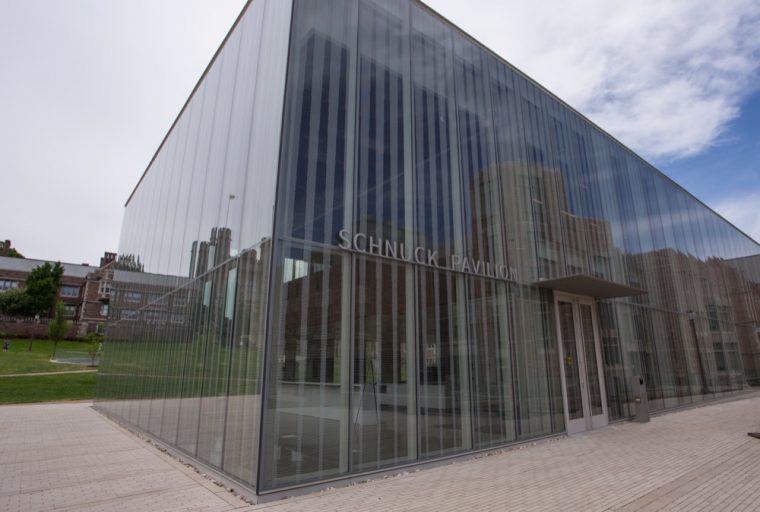 Photo by Grace Bruton
 According to the Washington University Office of Sustainability website, the US Green Building Council (USGBC) found that buildings across the country “account for 12 percent of all water use, 30 percent of greenhouse emissions, 65 percent of all waste output and 70 percent of electricity consumption.”
Wash. U., however, has committed in recent years to a Silver minimum requirement for Leadership in Energy & Environmental Design (LEED) certification for its buildings. LEED is a rating system that evaluates structures on sustainable features such as water efficiency, energy usage and innovation.
Railesha Tiwari, the sustainable design and construction project manager at Wash. U., who reports to both the Office of Sustainability and Office of Facilities, Planning and Management, says that LEED has “provided a good framework in unifying the building industry, giving a common language to what green buildings mean and what are some of the strategies that can be done in order to make a building more high performing and have sustainability aspects.”
LEED, among other rating systems such as Green Globes and the Living Building Challenge, are green rating systems that have been widely adopted across the United States.
Tiwari, who has been involved in the development of about 10 different construction projects following the LEED framework, gave a rundown of a few LEED projects that have happened and that are currently in the works.
“[The] East End is one of our largest construction projects in Wash. U.’s history, which comprises of four buildings and one underground garage,” she said. “So that’s five projects; four of those buildings: Weil Hall, Jubel Hall, [Schnuck] Pavilion and Sumers Welcome Center are pursuing LEED certification.”
The Danforth and Medical Campuses currently have a combined 21 LEED-certified projects. Parking garages, however, have a different process of certification, called Parksmart. An equivalent to LEED, Tiwari noted that Parksmart is a “specific certification that’s meant only for garages that are sustainable and green.”
One of Wash. U.’s newest LEED projects, McKelvey Hall on the East End, is going through the process of LEED v4 certification, the most current version of LEED. January Hall is undergoing a similar process.
“January Hall is also one of our first LEED versions for the commercial interiors, which is a different rating system,” Tiwari said. “It’s complete in terms of construction last year, and we are at the very end phase of the submission for LEED purposes, so it should be certified hopefully in the next few months.”
Tiwari noted that all new projects worth over five million dollars must pursue LEED certification, but she hopes to follow the LEED framework in all campus construction. Considering that Wash. U. requires a Silver LEED minimum for certification, nearly all new buildings and significant renovation projects budget over five million dollars.
“We’re also looking into standardizing our smaller projects, because there are quite a few small renovations that happen across campus with all the different buildings we have,” Tiwari said.
Additionally, Phil Valko, assistant vice chancellor for sustainability, provided insight into new projects that the Office of Sustainability is currently working on.
“Within the next couple of months, we’re going to be opening up the Active Commuter Hub in the Schnuck’s Pavilion building,” Valko said. “[Basically], it is a transit, bike and pedestrian commuter facility with showers, lockers and a bike parts vending machine. We’re really looking forward to finally opening that space.”
Valko is also working on a new solar installation across Wash. U.’s multiple campuses that is currently concluding its second phase and will make the University a leading solar producer in the area.
“[Many] solar panels [are] being installed on the Athletic Complex, some [are] being installed on North Campus and some [are] being installed on the School of Medicine,” he said. “So within the next couple of months, all of that solar will come online. And once it does, I believe we will be the number one producer of onsite solar in the St. Louis region as an entity.”
When asked about who “we” referred to, Valko said, “We, really, as Washington University. The project has taken many departments to get done, including facilities, including our treasurer’s office, our legal team…so, broadly, there are lots of departments working together that I think are very proud that we’re hitting this milestone.”
Stay in Touch!
Get the latest and top news from StudentLife delivered to your inbox