News
The fight for worker power comes to WashU
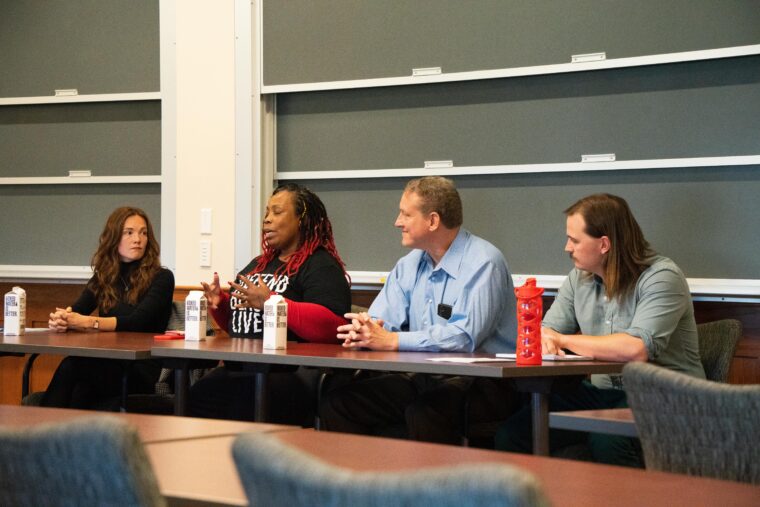
The Gephardt Institute for Civic and Community Engagement’s Civic Action Week hosted a panel where four worker-activists and a WashU professor discussed the history of labor power in the United States and the future of worker unions on Thursday, Oct. 19.
Speaking on the panel was Professor of Sociology Jake Rosenfeld; Laborers Local 42 unionist Sal Valdez; Director of Missouri Workers’ Center, Jeremy Al-Haj; Missouri Jobs with Justice organizer Ashli Bolden; and Joan Suarez, a former unionist for Workers United who served for over 30 years. Undergraduates Jeremicah Lott, Demarion Delaney, and Andrew de las Alas coordinated the panel.
After an introduction of all the panelists, members of the event began asking questions.
This year over 450,000 workers have gone on strike. After decades of decline in their movement, how has the weakening of labor power exacerbated income inequality?
Professor Rosenfeld began by explaining the stagnation and decline in worker pay (adjusted for inflation) over the past few decades. He associated this trend with the decline in labor unions.
“There is now a near consensus [that] flatline wages for average workers [are] intimately tied with the fact that we used to have one out of three workers in the private sector unionized — now it is one out of 20.” Rosenfeld said.
Panelist Valdez discussed the issue with both a historical and legal approach.
“My dad was a union member for railroad workers…I can remember the strikes and the tremendous sacrifice for fair wages.” Valdez said, “But now, laws have been made to make it very hard to organize, which [has] crushed us.”
Panelists Al-Haj, Bolden, and Suarez similarly discussed the suppression of union workers through “Right to Work” laws, through which employees can opt out of paying union dues while still benefiting from the union itself. The panelists explained that these laws make it logistically difficult for workers to properly organize.
With the rise of unions in recent years, many companies are beginning to automate their workforce. How should worker-power movements pivot to address this development?
Al-Haj responded to this question by denying that companies are mass-automating their workforces and disagreeing with the notion that companies are doing so to avoid worker organization.
“That [companies automating their workers] is a myth. That’s not true,” Jeremy said. “The potential automaton that people think is coming their way is far too expensive.”
Al-Haj said this in contradiction to studies and reports from labor experts, including one by Goldman Sachs in March of 2023 that indicated that 25% of jobs in the U.S. and Europe right now are either being automated or could be automated.
How can we get young people, especially college students or WashU students, involved in labor?
Bolden responded by removing any distinction between groups of American middle-class workers.
“I don’t understand why folks see themselves [as] separate from labor, right? If you labor, you’re a laborer. I don’t know if y’all need to have a Communist Manifesto reading group — so people understand the dignity of labor.” Bolden said.
The other panelists agreed and emphasized the importance for workers across the United States, in both public and private sectors, to organize and form unions.
In an interview with StudLife after the event, Professor Rosenfeld discussed his thoughts on the future of organized labor.
“On the one hand, we are in one of the more optimistic periods of my lifetime,” Rosenfield said. “[But] I think the broader barriers to real systemic change remain in place.”
Stay in Touch!
Get the latest and top news from StudentLife delivered to your inbox